

American Independence in Verse is on sale until July 4; details here.
America 250 on Mostly Aesthetics, part 7: America the beautiful.
Spencer Case claims that patriotism is “partly aesthetic,” in Why it’s OK to be Patriotic (see part I). Just as the lover admires what’s good in his country, he also strives to know, enjoy, and appreciate his country’s beauty. Spencer quotes George Orwell, loving England for its
solid breakfasts and gloomy Sundays, smoky towns and winding roads, green fields and red pillar boxes.
Ah, solid breakfasts! On the cover of Spencer’s book are the flags of many nations, the book is ecumenical, and the examples are literally all over the map—a good thing. So the book does not consider what is beautiful about America. But Spencer is an American patriot, as am I, and here and now is the time and place to shine a light on the beauty of this country. And so, I thought, well, I’ll write up something myself. But it’s hard! Purple mountains, amber waves of grain, yes, yes, but we don’t want the clichés, we want the subtle beauties, a statement of the American aesthetic that only a patriot could produce. So I asked Spencer if he would have a go. I was hoping for a few sentences. Here is what he sent.
What is the American aesthetic? The question sounds like the setup for a joke. It must be as brash as a billboard advertisement, as saccharine as a 64-ounce Big Gulp of Coke Cola, as unoriginal as a cliché line in a Hollywood action movie. That’s what a critic of American aesthetics might say, and there’s some truth to the charge. But what this critic might miss is that the garish exterior encloses an earnest, searching core.
A nation devoted to free enterprise and technological innovation might be expected to make a casualty of beauty. We don’t generally think of the light bulb or the elevator as objects of beauty. But they support novel kinds of beauty. Without them the skylines of Chicago and New York couldn’t exist. And some distinctly American innovations have opened our eyes to otherworldly beauty: the James Webb telescope’s images of the distant cosmos, or the mesmerizing Juno probe photos of Jupiter, revealing a maze of world-sized swirling storms, or the thrill of a Kennedy Space Center launch. Not least, there’s the automobile, not an American invention, but one improved and popularized in America, bringing with it the personal freedom of the road trip.
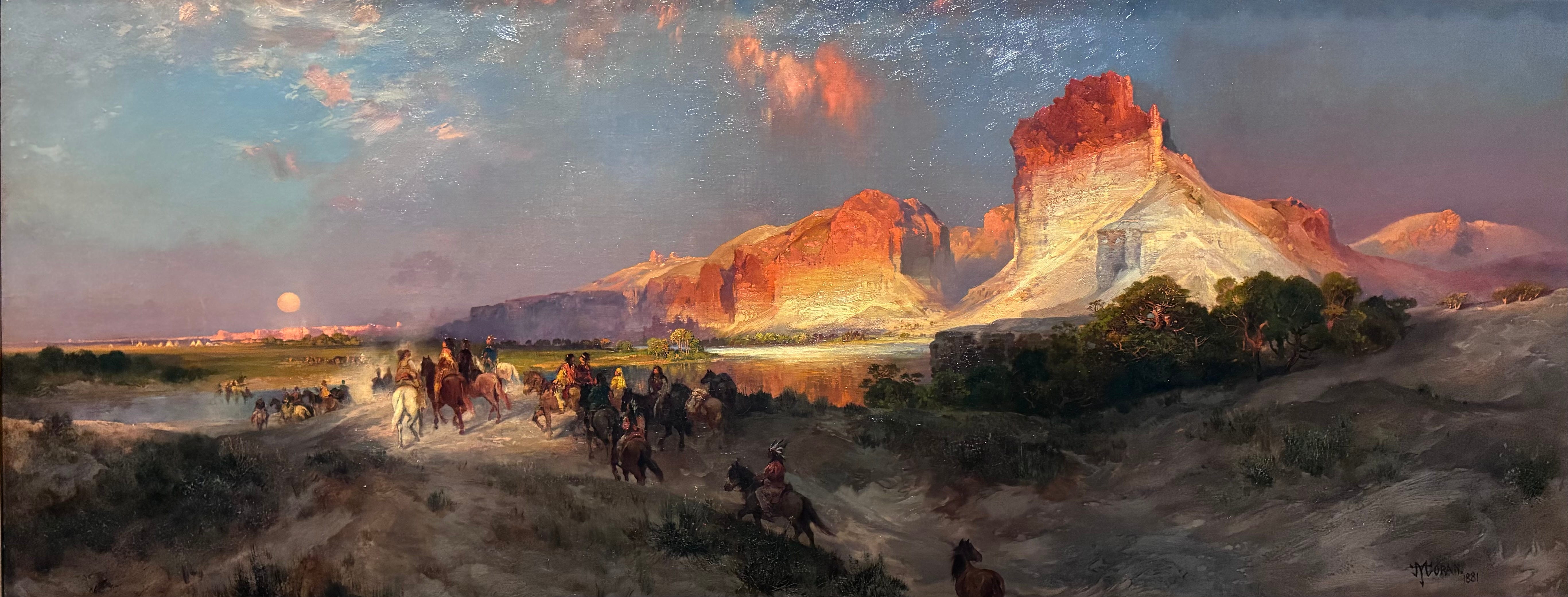
As with the patriots of other countries, I can’t help reading national values and aesthetics into the landscape of national territory. I’m primarily thinking not of the landmarks, the national parks, the skylines of Chicago and New York, but the liminal spaces between these popular destinations. When I was a graduate student, I drove regularly from Idaho to Colorado. This required crossing Wyoming, which I did between 60 and 70 times over a decade. At first, I found the drive tedious passing through places like Wamsutter and Buford, famous for having a population of exactly one (best of luck in the next mayoral election). And the wind, cold, and hail could be hazardous. But I came to find beauty in it. The landscape was vast and empty. So was the sky. Purple thunderstorms flickering with lightning were diminutive over peaks on the horizon, while the rest of the sky was an unthreatening blue, the summer shrugging off the gloom.
There’s one place I almost always stopped for gas: Little America, which bills itself as the largest truck stop in the world. For what seemed like hundreds of miles in either direction, billboards count down the distance and advertise its 50-cent ice cream cones and amenities. Almost there. Another 50 miles. Now 25. You’re almost there! One Mile Left! The exaggerated pride was mildly infectious, and maybe not insincere. I can’t speak to the water pressure or heat of the showers, but they really did have 50 cent ice cream cones. Quality services, promises kept, a satisfying stop on a journey: isn’t there a beauty to these things? Maybe Little America lives up to its name. Further down I-70, between Laramie and Cheyenne, a rest stop atop a mountain features a giant bust of Abraham Lincoln, surveilling with malice toward none, the unfolding of the union into the twentieth and twenty-first century.
And that century brought artistic innovations as well as technological ones: the syncopated rhythm of jazz, the effervescent phrases of Louis Armstrong’s trumpet. Or the dancing of Frankie Manning—the Ambassador of Lindy Hop, a dance itself named for Charles Lindbergh’s ‘hop’ across the Atlantic—who carried that tradition to its most energetic peaks and then transmitted it into new generations. He is a beloved figure among swing enthusiasts and an unsung titan of American culture outside that circle. Spiritual and material strivings are juxtaposed, even intertwined: God and mammon in uneasy alliance, individualistic and sometimes too boastful, but not complacent and certainly not static, like a jazz solo.
A final image: in 2017, I finally made a trip in which Wyoming was the destination to observe a total solar eclipse whose umbra passed over the Big Sky state. For a few days, the state’s population more than doubled as outsiders flocked in cars, trucks and campers to observe this unauthorized foray of night into day. Something wonderful, even sublime, keeps us looking up to a new frontier.
Spencer Case is a Postdoctoral Research Associate at the Center for the Philosophy of Freedom at the University of Arizona, and a veteran of the US Army. He writes about war ethics, moral realism, and political philosophy, and podcasts at Microdigressions.
Read more of America 250 on Mostly Aesthetics: