

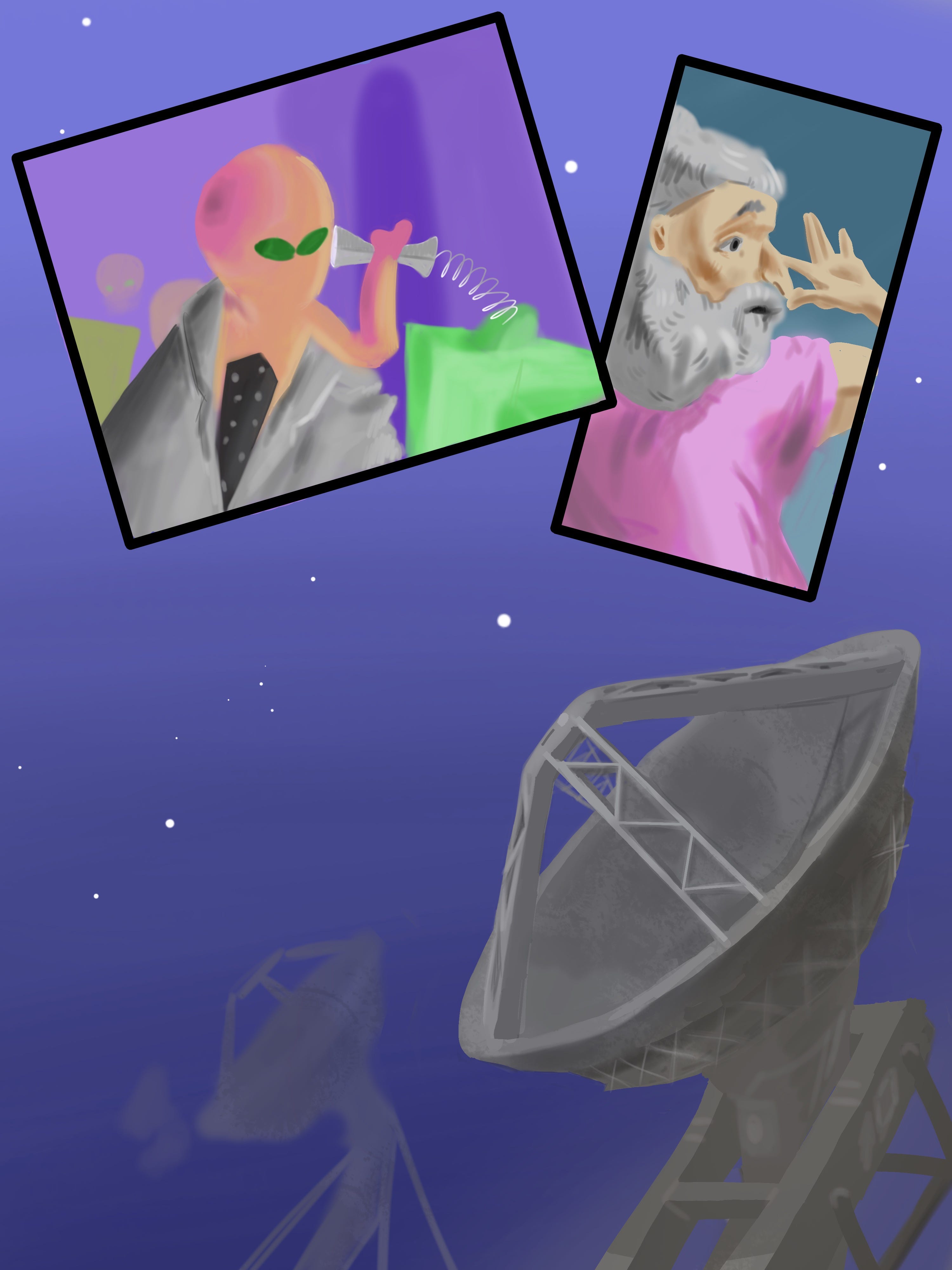
In the sci-fi film Contact Dr Eleanor Arroway is in love and at odds with Palmer Joss, a man of faith. Joss first presents as a writer and a defender of local communities, but Arroway soon learns he’s a lapsed seminarian—he “couldn’t live with the whole celibacy thing,” as it clear from how quickly he takes her to bed. His is the weaker performance, as Jodie Foster (Arroway) is better at playing a skeptical scientist, than Matthew McConaughey (Joss) is at playing a devout Catholic. Arroway can’t take religion seriously, and says to Joss:
what’s more likely? An all-powerful, mysterious God created the universe, and then decided not to give any proof of his existence? Or that he simply doesn’t exist at all and that we created him, so we wouldn’t have to feel so small and alone?
In the film’s second act, Joss betrays Arroway. She’d discovered a message from Vega, proof of extraterrestrial intelligence. The message is decoded and found to contain blueprints for a space vehicle, but where it will go, no one knows. Then follows a contest: who will represent humanity to the aliens? The Americans acknowledge, to themselves and behind the scenes, that an American will be chosen. That means Arroway has only one competitor, David Drumlin, former science advisor to the President. Drumlin has sought to upstage and undermine Arroway throughout the film, and for her entire career, and he is worth booing every time he appears on screen. Joss is on the selection committee, and he sabotages Arroway’s interview, by asking if she believes in God. She evades, complains about lack of evidence, questions the relevance of the question, and is rebuked by a committee member:
Ninety-five percent of the world’s population believes in a supreme being in one form or another. I believe that makes the question more than relevant.
Drumlin then smirks through some pious remarks, a snake lying through his teeth, and the job is his. But a terror attack on the vehicle kills Drumlin, and Arroway becomes the pilot for the backup vehicle, built in secret off the coast of Japan, whose existence is explained in one of the film’s better lines: “First rule of government spending: why build one, when you can have two at twice the price?”
The vehicle “works,” as far as the humans can understand, by dropping a spherical pod into some spinning circular thingys, at which point...well, as Dr House often said, no time for tests. Down Arroway went. We see her traverse a wormhole, visit several star systems, and she is overcome by the beauty of what she sees:
No words, no words, to describe it. Poetry. They should have sent a poet. It’s so beautiful....I had no idea.
She converses with an alien, who takes the form of her dead father, whose death by heart attack she witnessed at the age of nine—and, pause for a minute. Arroway is fooled at first, and thinks she’s really talking to her dad, but not for long, and the alien addresses her natural confusion—
we thought this might make things easier for you
—which, I don’t know: dredging up trauma from her youth, and proving they’ve scanned her mind and her most guarded memories, seems to me the opposite of comforting. How superintelligent can these aliens be, if they couldn’t pass Human Psychology 101?
But the ending of the film is what I really want to talk about. When Arroway returns to earth, she has no evidence or proof that she ever left. All the observers saw, and all that the “forty-three separate remote cameras” recorded, was her pod falling straight through the spinny things without pause or interruption. The video and audio recording device she wore throughout, and diligently used and maintained, showed nothing but static. During the follow-up congressional investigation, she battles skepticism incarnate in James Woods, who plays the National Security Advisor:
You come to us with no evidence, no record, no artifacts. Only a story that, to put it mildly, strains credibility. Over half a trillion dollars were spent. Dozens of lives were lost. Are you really going to sit there and tell us we should just take this all on faith?
Arroway replies:
I had an experience. I can’t prove it. I can’t even explain it. But everything I know as a human being, everything I am, tells me it was real. I was given something wonderful, something that changed me forever. A vision of the universe that tells us undeniably how tiny and insignificant and how rare and precious we all are. A vision that tells us that we belong to something that is greater than ourselves, that we are not, that none of us are alone. I wish I could share that. I wish that everyone, if even for one moment, could feel that awe and humility and hope.
Jodie Foster is a marvel in the film. Her Arroway has a soul of iron, and a face that’s vulnerable and transparent. In each scene it shows an infinite range of emotions, like subtle waves in grains of sand. These factors combine to make her speech in Congress moving, as a spectacle; but as a plot turn it’s ham-fisted and weak. Do you get it?—Arroway, the skeptical woman of science, now sounds just like Joss, the credulous man of faith. The filmmakers, and Carl Sagan (who wrote the book on which the film is based), wanted, I think, to make an epistemological point. Those who believe in God cannot be criticized, for believing things they cannot prove to skeptical third-parties, because everyone does, or may easily come to, believe such things, and be rational in doing so. But that point can be made, without bringing in the meaning of life and our place in the universe, the topics of Arroway’s speech. When Peter van Inwagen defends religious belief against “epistemological minimalism,” which Arroway endorses several times in the film (all before her mind-expanding journey)—a theory of knowledge that admonishes us,
Don’t accept any proposition not subject to straightforward factual verification unless that proposition is endorsed by the sciences or is necessary for explaining some global fact that the sciences leave mysterious,
he emphasizes its absurd consequences in domains far from religion or the meaning of life, suggesting there is no real difference, with respect to this principle,
between an atheist and theist (on the one hand) and (on the other) two equally expert and informed astronomers in, say, 1994, one of whom thought that gamma-ray bursts occurred inside our galaxy and the other of whom thought they occurred at cosmic distances.
Epistemology is a cold-blooded discipline, best pursued by shy and quiet reptiles. But Arroway’s blood is up, and she sounds like a prophet, who has been delivered a vision she can tell about but cannot share, and with those limited means must convince a stiff-necked people to trust and follow her. Her frustration is the frustration of a saint and mystic:
It seems to me that if all creatures had received the same graces I received, God would be feared by none but would be loved to the point of folly. (St Thérèse of Lisieux)
Thus Arroway’s appearance before all those fancy government officials is powerful, and totally unfit for the material that is meant to justify it. An experience of God, and a knowledge of God’s love, would be “something wonderful” that would “change you forever,” and could tell us we “belong to something greater,” and “how tiny and insignificant and how rare and precious we all are.” But I don’t see how meeting some aliens could do that. Wouldn’t meeting aliens make us seem less rare and precious? And “none of us are alone”? There are eight billion human beings on planet earth. If despite that you feel alone, then learning of intelligent life on other planets, of a universe teeming with such life, would not help; I do not understand how it would help. Knowing God, and knowing of his love for you and all creation, might make you feel less alone, but not that.
But let us grant that Arroway was (in her words) “given something wonderful,” and that she understands, for the first time, that we are “part of something greater”—a bit more plausible, if we include not just the aliens, but the beauty and sublimity she experiences en route. She says she’s “changed forever,” but how? Throughout the film Joss has been her mirror and her foil, and now we are to believe they are the same, except Arroway’s faith is in aliens and not in God. But how much is she like him—or like him if he were as he is supposed to be, a truly religious man? The prompt is the same: each has received a gospel, and Arroway is eloquent to her interrogators about its newness, and the goodness of that news. Her reaction is usefully compared to some paradigms. When Jesus told Peter and Andrew to “follow me,” they “immediately left their nets,” abandoning career and livelihood. When Paul the Apostle was struck blind and instructed by Jesus, he turned away from who he had been and what he had stood for—a zealous persecutor of Christians—and became something that could (and would) easily get him killed, the lead advocate and defender of that religion. But where is Arroway, and how does she change her life, after her revelation? Back where she was before, in New Mexico, building more telescopes.
See also: Hide Not Your Face From Me; The Plague Crucifix; On Fear of Religion.
Sources: Peter van Inwagen, Reply to Sean Carroll; Story of a Soul: The Autobiography of St. Thérèse of Lisieux; the Gospel According to Matthew.