

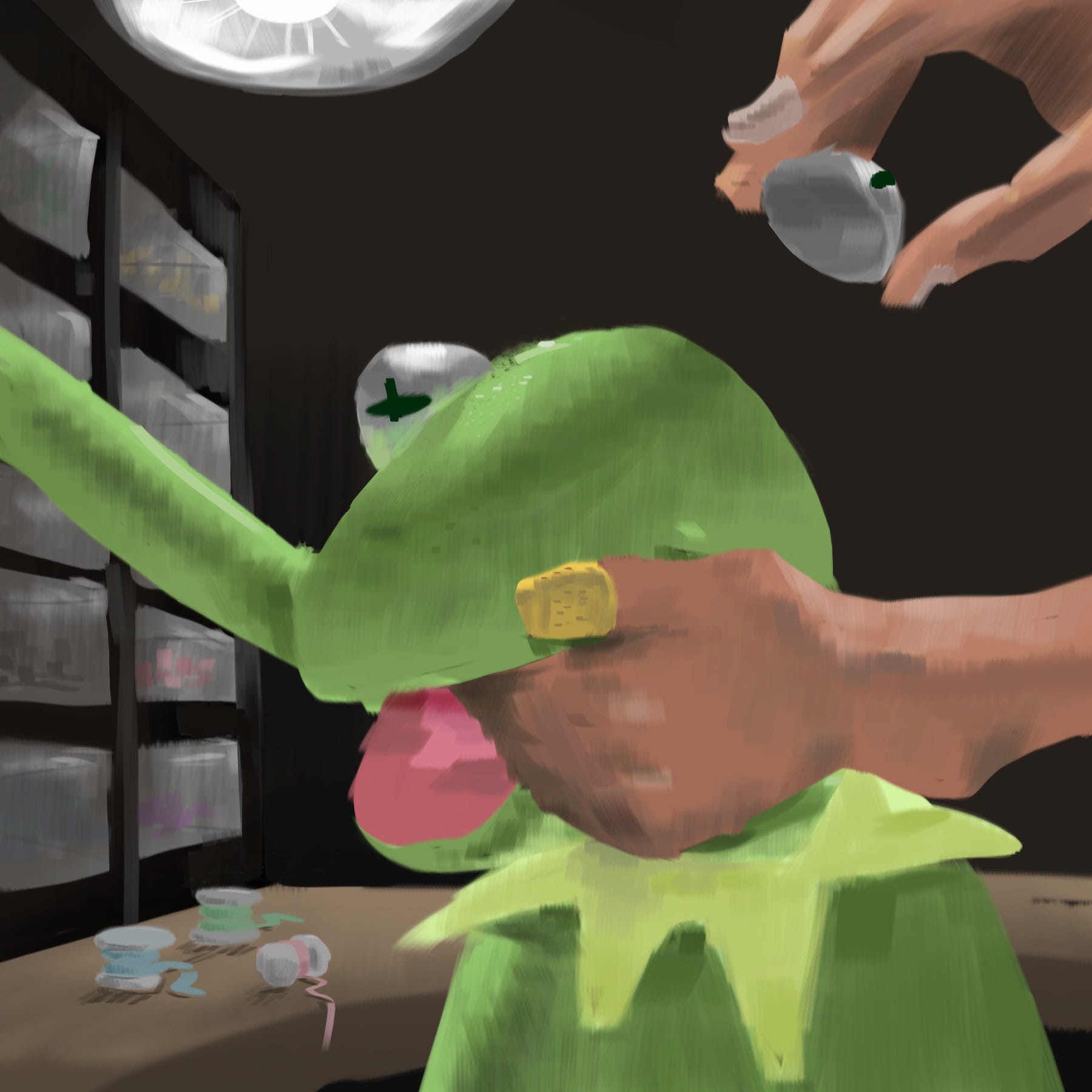
Jim Henson knew from the first that he wanted to work in television. Then, when he was a senior in high school, a job opened at a local station. The ad asked for
youngsters twelve to fourteen years of age who can manipulate marionettes.
Alas, Henson was not someone “who can manipulate marionettes,” nor puppets of any kind, in fact puppets were nothing to him:
When I was a kid, I never saw a puppet show...I never played with puppets or had any interest in them.
But if getting into puppetry would get him into TV, Henson was game. Still: if there had been a better-fitting job, there would be no Muppets.
How did Henson sell himself as the best puppeteer on offer? He had one week to prepare. Kids, this was the early 1950s, there were no YouTube tutorials to binge watch. Instead he went to the low-fi internet of the day—the public library—checked out two books, and spent the week reading them. That this was enough, indicates either the weakness of the applicant pool, or the mind-blowing talent Henson had just unlocked.
A year later, Henson and his future wife Jane were producing a five-minute show called Sam and Friends. This is when the first Kermit (not yet the frog) puppet was made. Kermit is a lesson in simplicity:
There was nothing in Kermit outside of the piece of cardboard...and the cloth shape that was his head. He’s one of the simplest kinds of puppet you can make, and he’s very flexible because of that...which gives him a range of expression. A lot of people build very stiff puppets...and you can get very little expression out of a character that you can barely move.
Possibly, Henson’s puppets were different because he hadn’t been trained to build puppets, by the wizened hands of a living puppet-making tradition: he had no “relationship to any other puppeteer.” But why did puppets tend toward the inflexible? Because that flexibility, and the range of expression it made possible, had little value. Only a few kids can sit near the front of a puppet show, and even they might be ten feet back. The rest, even further away, can’t see subtle expressions on a puppet’s face. So there was no point in making them.
But Henson wasn’t putting on a puppet show. This was his key, almost philosophical insight. Nor was he broadcasting a puppet show on television. Instead he was broadcasting a puppet television show. It’s like the difference, that the philosopher Arthur Danto remarks on, between a painting of a beautiful mountain, and a beautiful painting of a mountain (this is in The Transfiguration of the Commonplace). Under an old theory of art, these were the same, because the medium—the paint on the canvas—was meant to be transparent: one was to look “through” the canvas to the scene it represents. When artists realized that “beauty” could apply to a painting, without applying to what it was a painting of: this was a revolution. It was a similar twist, to conceive of a puppet television show, as something other than a puppet show on television.
Puppet shows—in-person—use puppet theaters. The theater serves two purposes. It gives the puppeteer a place to obscure himself from view. It also demarcates the space in which the imagined action of the show is to take place. Outside the confines of the theater, the puppet is a painted piece of felt and wood. Inside the theater, it is a king, a princess, a horse. If one wants to broadcast a puppet show, one asks the puppeteer to set up his theater, and one aims the camera at the set-up. But a puppet television show does not need the theater, because the viewer already has, in his home, the machinery that “demarcates where the imagined action takes place”:
Jim saw that no puppet theater was needed at all...the space between the four sides of the TV screen was his puppet theater.
The special affordances of any technology take time to discover. The first recordings of music were made by simply hanging a microphone and asking the band play, as they did during any live performance. Only later was it realized that one could mix multiple tracks, recorded separately; that one could place the mic closer to the singer’s mouth than any listener’s ear could ever be, and thus make recordings whose sound was impossible to achieve live, without technology that existed only in the future. (This arms race of course continued, for even after live performance with large speakers and multiple microphones became possible, artists—this is the famous story of Pet Sounds and Sgt. Pepper’s Lonely Hearts Club Band—would find new ways to record unperformable music).
The same, for television. One’s first thought is to point the camera at an act that could be performed and appreciated without a camera. But so much more is possible, if you care only about what the camera sees, and allow whatever kludges are needed to put your vision into that window to remain visible outside the frame. Immersion in the Muppets is impossible, if you’re a live observer on set.
Making this idea work wasn’t a snap. If you’re performing for the camera, you have to know what the camera sees. A human actor can take subtle direction between takes, but a puppeteer, crouched out of the way, hand stuck up in the air, needs more immediate feedback. To solve this problem, Jim Henson invented to use of hidden monitors for the puppeteers. Now they could see the very images the camera was sending out, even while they were performing. (If you were playing Big Bird, you had one of these things strapped to your chest, inside the suit.)
The analog of the close-miking of a singer, is the close shot of the actor—or Muppet. And this is why the extra expressive Muppet faces were a boon, not an irrelevancy. In the age of television, the puppets too needed to be ready for their close-up:
the Muppets could move freely anywhere in the viewing area, even approaching the camera—and the audience—for an intimate close-up, something that could not happen with a traditional puppet theater. This was something brand-new: it was puppetry made expressly for the medium of television.
Those who study innovation say that new ideas often come from ignorant outsiders who haven’t “learned what can’t be done,” and so find a way to do it. Jim Henson drew this moral himself:
...his relative inexperience in both puppetry and television allowed him to look for solutions that might not have occurred to more seasoned performers, even when, as in the case of the television monitor, the solution was lying in plain sight. “Many of the things I’ve done in my life have basically been self-taught...I had never worked with puppets....and even when I began on television, I didn’t really know what I was doing...I think if you study—if you learn too much of what others have done—you may tend to take the same direction as everybody else.”
He did not take the same direction, and his strange newness inspired others to join his band of maniacs, and become his close collaborators. Jim Henson seems to have had a kind of Steve Jobs energy, but it did not strike one at first, it happened when he began performing:
Jim seemed so utterly normal...[he and Jane] looked as average and suburban as actors in a Chevrolet commercial.
That was Jerry Juhl’s first impression (Juhl was the first puppeteer hired by Muppets, Inc). But then “Jim opened the box, took out his Muppets one by one, and began to perform”:
The things he brought out of that box seemed to me to be magical presences, like totems, but funnier. An angry creature whose whole body was a rounded triangle; a purple skull named Yorick; a green froglike thing [you know who that was]....Who was this Henson guy?
Psychologists say that we judge whether something is an X—house, car, puppet—not by checking whether it meets some definition, but by evaluating how “close” it is to a “paradigm” or “prototypical” X. Today, the prototypical puppet is a Muppet, but when Henson invented them Muppets were deviant, and it was through him that they moved from margin to center. As Juhl says, continuing the previous quote,
These things weren’t puppets—not as I had ever seen or defined them....This guy was like a sailor who had studied the compass and found that there was a fifth direction in which one could sail.
It was the same when Jim met Frank Oz, another genius who never wanted to be a puppeteer:
He [Jim] was this very quiet, shy guy, who did these absolutely fucking amazing puppets that were totally brand new and fresh, that had never been done before.
It’s sad, in it’s way, how lost to us this discovery is: for us the Muppets are nostalgia, they are warm childhood memories, but then, the Muppets were edgy, dangerous, they were radioactive mutants of entertainment.
Source: Jim Henson by Brian Jay Jones.
See also: Disneyland as Art and Representation.