

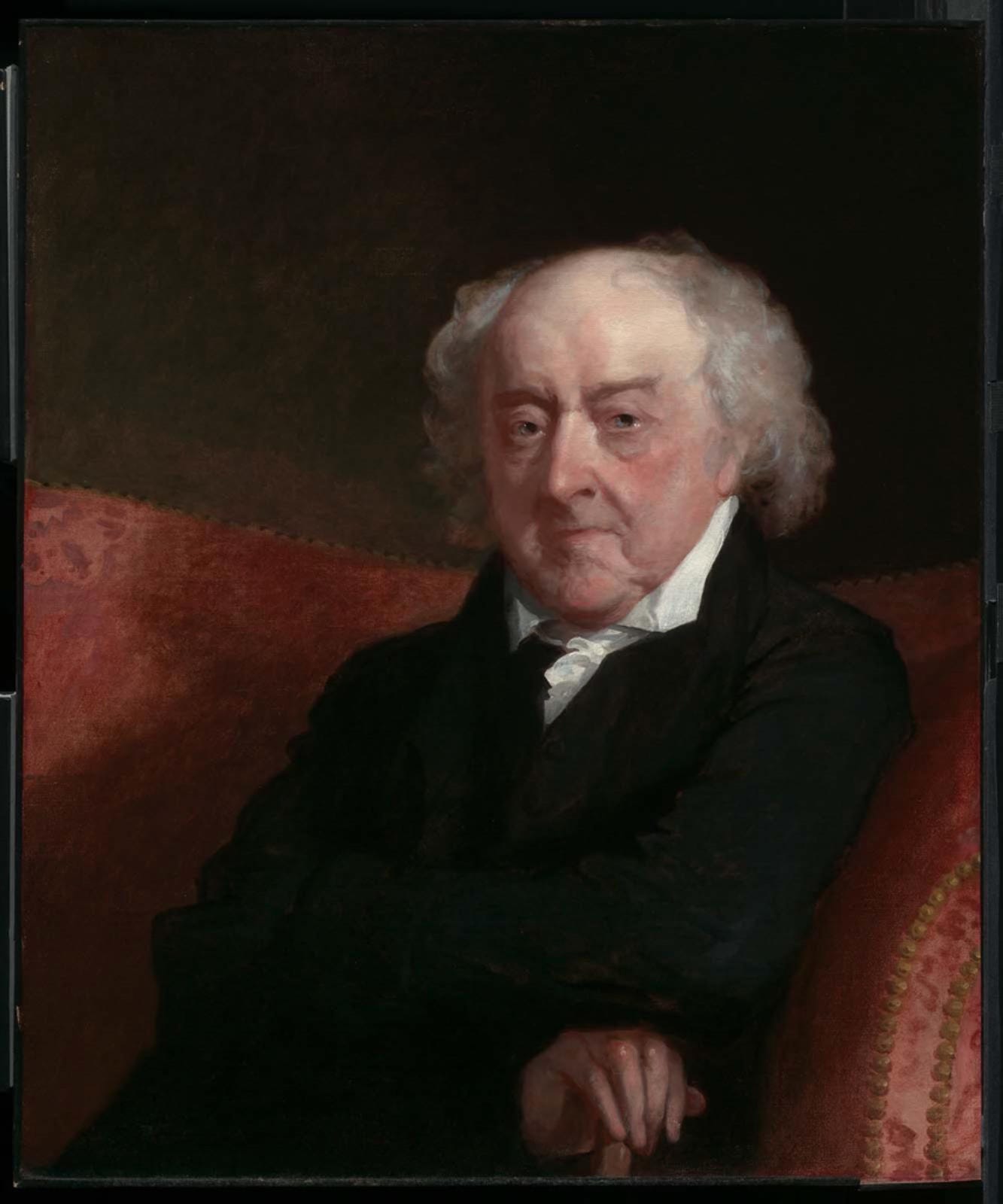
John Adams grew up in Braintree, Massachusetts, thirteen miles south of Boston. When, much later, he left for Philadelphia and the wider world—Congress, France etc—he never once wrote his mother, “nor mentioned her in his diary or correspondence,” which runs past fifty volumes.
Similarly, Thomas Jefferson lived with his mother off and on for twenty-seven years, but “only four references to her can be found within his voluminous papers.” As a student Jefferson was “shy, socially backward, and lacking in self-esteem.” But he loved to learn, indeed he became an “obsessive student,” so obsessed that he “once contemptuously referred to most of his schoolmates as wastels who made for bad company.”
Adams studied at Harvard: of course. As a young man he was “gruff and self-centered.” Pondering careers, he supposed he should become a lawyer, but he was “racked by doubt.” When he opened a law practice in Braintree, “only two [clients] knocked on Adams’s door during his first year in practice, and he lost one of those cases by preparing a defective writ.”
George Washington was put in command of the Virginia Regiment in 1754. He then fumbled an encounter with French troops, and inadvertently started the French and Indian War. The conflict spread to nine nations fighting on three continents, and so, in effect, Washington may be blamed for “World War Zero.” As a leader the young Washington was “so self-absorbed that he spent barely one-quarter of the first six months [of his command] with his army.”
Jefferson was smitten with a girl named Rebecca, but he was “too shy for the relationship to proceed very far.” All he managed was to obtain her silhouette, which he “carried...everywhere in a locket.” He could not do more, for he was paralyzed by a fear that “she would rebuff his advances.” Finally, at a ball, he approached her, but despite the Cinderella setting he only “stammered a few broken sentences, uttered in great disorder and interrupted with pauses of uncommon length.” When later she became engaged to someone else, he suffered a “violent migraine,” and for six years “made no attempt to squire any young lady.”
What about John Adams’s love life? His “upbringing instilled in him a lifelong prudishness that bordered on the pathological.” He “felt uncomfortable in the presence of most women,” finding it “difficult to make conversation.” That problem wasn’t limited to the fairer sex:
he never learned the arts of swapping jokes or spinning off-color yarns, and never knew what to say when the conversation turned to what he regarded as men’s favorite subjects: women, horses, and dogs.
Adams nevertheless succeeded in courting and marrying Abigail Smith, an astonishing woman who, today, has her own volume in the Library of America, and her own Institute at Harvard University. Benjamin Franklin’s wife could not spell; Abigail LARPed with her husband as Roman nobility, and signed her letters “Portia.”
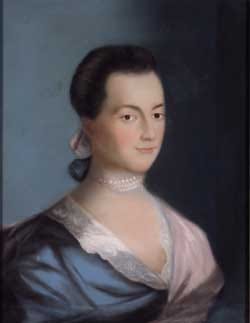
Two years after the wedding husband and wife sat for a portrait. John “was overweight, pasty, and flabby. He admitted to being thick, but Abigail said he was ‘so very fat.’” Not to be outdone, Adams called himself prudish, stuffy, stiff and uneasy. A family man now, Adams was “a distant father,” not even in town for the birth of his first child, or the birth of his second. As mentioned, Adams constantly recorded his thoughts, in diaries and letters, but
he said nothing about his children in his diary during the first several years of marriage, although his entries ramble on about myriad topics, including the children of others. When Adams finally mentioned his children, it was to complain about the distractions they caused.
After the Boston Massacre, Adams took a big step into public and political life, and served as defense counsel for the accused British soldiers. He won acquittals or light judgments for all. But then he fell seriously ill, and blamed his illness (probably correctly) on the stress of political activism. So, in 1771,
at age thirty-seven Adams...resolved to never again have anything to do with politics.
In 1758/9 Washington retired from arms, married Martha Custis, “the wealthiest widow in the colony [Virginia],” and settled into life as a planter. Now lord of Mount Vernon, Washington was “driven by...acquisitiveness,” sending “one shopping list after another to London.” He was especially “acquisitive” when it came to land, or as we would say today, real estate. Deception, shadiness, these were his standard procedures. Land in the west had been promised to veterans of the war. Washington arranged to inspect the land on their behalf. He then lied to them about its quality—“very hilly and broke,” unsuitable for farming—and bought it from them cheap, “ultimately acquiring 20,147 acres.” Later the men “began to feel they had been duped,” as indeed they had. One former aide said “I am sure I never desire to deal with him for 6 [cents] again.”
In the Virginia House of Burgesses Jefferson exhibited “poor posture” and a “tendency to slump when seated,” and struck those who did not know him as “reserved even to coldness.” He hated public speaking, and what speeches he did make were in “a weak, barely audible voice”:
Not one observer at any moment in Jefferson’s public career ever claimed to have heard him deliver an effective speech.
He married a woman named Martha (strange coincidence), but “said next to nothing about her.” He did write that, for any wife, “all other objects must be secondary to that of pleasing her husband,” and she should take “daily care to relieve [his] anxieties.”
Then, in December 1773, probably at the direction of Samuel Adams, several colonists costumed themselves as Indians and dumped 340 chests of tea into Boston harbor. In retaliation, Parliament passed the Intolerable Acts, closing the harbor and revoking Massachusetts’ charter. You know the rest.
(Quotations from Setting the World Ablaze, by John Ferling.)
See also: Young American; Before Washington.
American Independence in Verse, now available for purchase.