

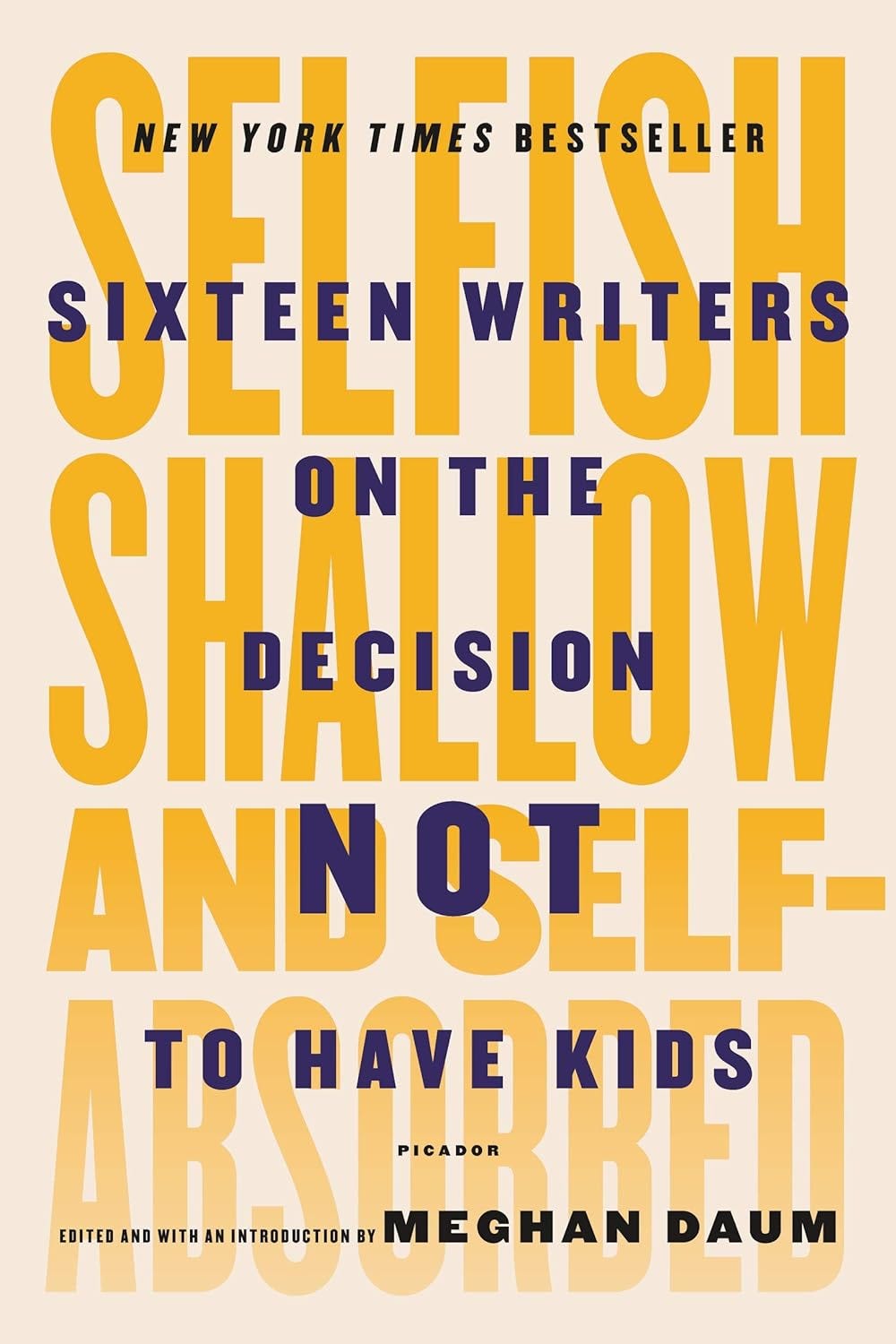
Only a “handful of reasons” move people to have children, and often they’re moved by no reason at all, but by something primal, a “biological imperative”: so says Meghan Daum, in the introduction to this book. It’s different, she thinks, with the deliberately “child-free.” Here you’ll find diversity, complexity, and drama:
Those of us who choose not to become parents are a bit like Unitarians or nonnative Californians; we tend to arrive at our destination via our own meandering, sometimes agonizing paths.
Since “no two reached that decision in quite the same way,” Daum solicited more than two essays, by child-free writers, in which they would explain their child-free state.
But in fact, with a few exceptions, only three motives are mentioned in the sixteen chapters of this book. First, is never having been gripped by a craving for children of your own:
There was no corresponding baby hunger, at least not in that ready place where all my other hungers were shouting for attention. (Courtney Hodell)
Hunger crowds out other thoughts and desires, and even affects what you see, smell, and taste. To a starving man, any foodstuff is technicolor, and everything else is dingy gray. Conversely, the absence of a hunger goes with a loss of salience, of the thing it is a hunger for:
from the time I was a young girl until well into my thirties, I did not fantasize about having babies, or find others’ babies of much, if any, interest. (Anna Holmes)
Children seemed as far off as false teeth, and interested me about as much. (Michelle Huneven)
So if you don’t have baby fever, have a baby must compete, in the moment, with finish my book, travel the world, or whatever, and tends to lose a fair fight on an open field:
It always seemed like an interesting future possibility, the same way that joining the Peace Corps someday seemed like an interesting future possibility. (Laura Kipnis)
Courtney Hodell worried that her lack of desire was a defect, “pathological.” But from a design standpoint, evolution did not need baby fever to secure its objective, as other appetites—you know which, and none of these authors disavows them—were, in the ancestral environment, enough to guarantee the reproduction of the species. So maybe it’s an example of “evolutionary mismatch,” that those other appetites now rarely have the effects that so-enamored them to natural selection. We must now deliberate about having children, in a way past humans did not. Is this tragedy, comedy, or both?
Kate Christensen, an exception among these writers, does experience “baby lust,” though in the end she never one. She’s as if possessed by an alien spirit, or become an alien herself—almost, one wants to say, struck down and transformed—and her description of her new world is the most affecting moment the book:
Suddenly, I had baby lust: deep, primal, a shockingly animal yearning I’d never experienced before....I fantasized about nursing her, rocking her to sleep, leaping out of bed in the night when she cried.
Where are my children? I felt their absence and loss as if they existed somewhere I couldn’t reach, as if they were stuck forever on the other side of a membrane and I could never have access to them. I felt as if they were real.
The second common motive, is liking or delighting in activities that parenthood makes hard or impossible:
I liked having the kind of life where you didn’t know what was going to come next; the opposite of what life as a mother would be, or so I presumed. (Laura Kipnis)
Try this on. What if I didn’t want to have babies because I loved my job too much to compromise it, or because serious travel makes me feel in relation to the world in an utterly essential way? (Pam Houston)
(That’s so bloodless, “in relation.”) Jeanne Safer also includes “traveling the world” on her list, as well as
sleeping until noon, or going out to dinner or the movies at midnight on occasion.
Of course, becoming a parent might change you, so that you now like “having the kind of life” where your children depend on you for love and care, where meeting those needs seems the most important thing in the world, and how great is a midnight movie really? Pam Houston loved being able to visit Tibet; a friend, who had taken the baby plunge, told her,
when you look into your baby’s eyes, that will become your Tibet.
That’s why the second motive usually arrives with a third, allied to it: the conviction that the activities of parenthood are too hard, and not worthwhile. Most blunt of all are Danielle Henderson and Tim Kreider:
parenting had always struck me as an extreme pain in the ass, a total time suck.
I once described being a parent as like belonging to a cult, “living in conditions of appalling filth and degradation, subject to the whim of a capricious and demented master.”
Courtney Hodell writes that her mother
was everywhere and nowhere, constant but peripheral, the separate acts of care like salt grains dissolved in water.
Later Hodell writes this, about friends and acquaintances who became mothers:
I was staggered by the transformation of these women. Their devotion, their patience...They were going to wipe the face, wipe the bottom, feed, bathe, lull, teach by word, teach by example, read the books, put away the toys, buy the tiny clothes, six months later buy a slightly larger set of clothes, fret about the schools, and on and on; the caring and the worry was never, ever, ever going to stop, not until death. I wasn’t sure I had it in me.
The “staggering transformations” Hodell saw included the acquisition of virtues: devotion, patience. Even if she wasn’t sure she “had it in her,” she regarded those traits as good. But other writers think parenthood changes you for the worse. Rosemary Mahoney thought that motherhood would push her past virtuous devotion to its vicious extreme:
it was precisely that unavoidable, slavish, evolutionary devotion that worried me. I knew I would not be strong enough to resist it. I would become, to my discredit, entirely servile.
(But would it look like slavishiness and servility from the other side?) For Laura Kipnis, it wasn’t the character traits mothers acquired that repelled her, it was the psychic states motherhood caused:
the mothers I met struck me as a strange and unenviable breed: harried, hampered, resentful. I didn’t want to accidentally become one of them.
“Harried, hampered, resentful”: you’ll be like that, if you commit to and pursue any demanding, all-consuming project. Building a cathedral, the workers will “lay the brick, color the glass, install the windows, hoist the beams, and on and on”; in the past, more than one lifetime of effort was required. It is, indeed, hard. But are not these activities, perhaps of little value in isolation, part of a grander project that is worth doing, and is not the final result something wonderful? These writers don’t say yes, and don’t say no; they attend to certain parts, or aspects, of bringing into the world and raising up a new life; they are silent on the larger question.
The strangest essay in the book is by Lionel Shriver. The other writers defend or explain their choice. Shriver does this too, and then does more, telling us the stories of three child-free women she interviewed. Hearing them soured her on their reasons:
Contentment. Happiness. Satisfaction. Fun. There’s nothing, strictly speaking, wrong with these concerns, but they are all of a piece. They fail to take into account that our individual lives are tiny beads in a string. Our beloved present is merely the precarious link between the past and the future—of family, ethnicity, nation, and species. We owe our very contentment...to the ingenuity of our ancestors. Yet it rarely seems to enter the modern “childfree” head that proper payback of that debt might entail handing on the baton of our happy-happy heritage to someone else.
One of Shriver’s interviewees said “I think I am a squanderer of my gifts and my heritage.” (To squander: to waste, to lose through negligence or inaction.)
A debt to those who brought us into the world, and gifted us wonders; the “handing the baton of our heritage to someone else,” as the “proper payback” of that debt; the creation of those “someone else”s as part of that payback—Shriver floats these ideas, and then admits that they do not move her:
There is no generalization in this article, no matter how harsh, that would not apply to me. I care about my own life in the present. I think I should be, but [...] I’m honestly not very fussed about what happens after I die.
Shriver suggests, also, that forgoing parenthood can be a form of pessimism, and a failure to love humankind as one should:
Surely the contemporary absorption with our own lives as the be-all and end-all ultimately hails from an insidious misanthropy—a lack of faith in the whole human enterprise.
the growing cohort of childless couples determined to throw all their money at Being Here Now...has the quality of the mad, slightly hysterical scenes of gleeful abandon that fiction writers portray when imagining the end of the world.
Most of the essayists set a theme at the outset, and spend the balance of their time developing it. Shriver’s essay is one exception, but more extreme is Tim Kreider’s, which shocks you with the grinding gears of its changes in tone. He first wants you (or anyway me) to hate him:
Raising children is one of many life experiences I’m happy to die without having had, like giving birth, going to war, spending a night in jail, or seeing Forrest Gump.
(Among other things to hate, that Forrest Gump joke is lame.) He thinks life is meaningless, having children doesn’t change this, and that humans rationalize their acts after the fact, but are not moved to those acts by reason:
I don’t believe [parents] choose children any more than naked mole rats decide to start tunneling.
The twist begins when he says his “own upbringing was just fine”—except for the fact that he was “given up for adoption when I was a few days old, which, I’ve since read, can do something of a number on a kid.” Either he can approach the damage adoption did him only obliquely, by joking about it; or, worse, he can apprehend it only from the third-person. Either way, nihilism has mixed with resentment. A few paragraphs later, all the stuff about how he “never understood why anyone else was doing it [having children]” turns out not to be entirely true, but just a phase:
It wasn’t until relatively late in life, when I met people I was biologically related to for the first time, that I had some glimmering of how parents must feel about their children.
When I look over at one of [my half-sisters] next to me in a car or at a party I secretly thrill with a warm, narcotic love. If one of them needed a kidney, I would give her one; if the other needed one, I would with some regret, give her the other.
Even adjusting for hyperbole, the nihilist has some heroism in him. And then, in explaining why he’s afraid of having children, he implies, better than anyone else in the book, how valuable children are:
I’m afraid that if I ever did have children of my own I would love them so painfully it would rip my soul in half, that I would never again have a waking moment free from the terror that something bad might ever happen to them.
Only something sacred could merit a response so extreme.
See also: “In Their Own Image.”
(Below the fold, for premium subscribers: the demands of the writer’s life; binge drinking; childlessness as maverick or normie; and the best essay in the book.)