

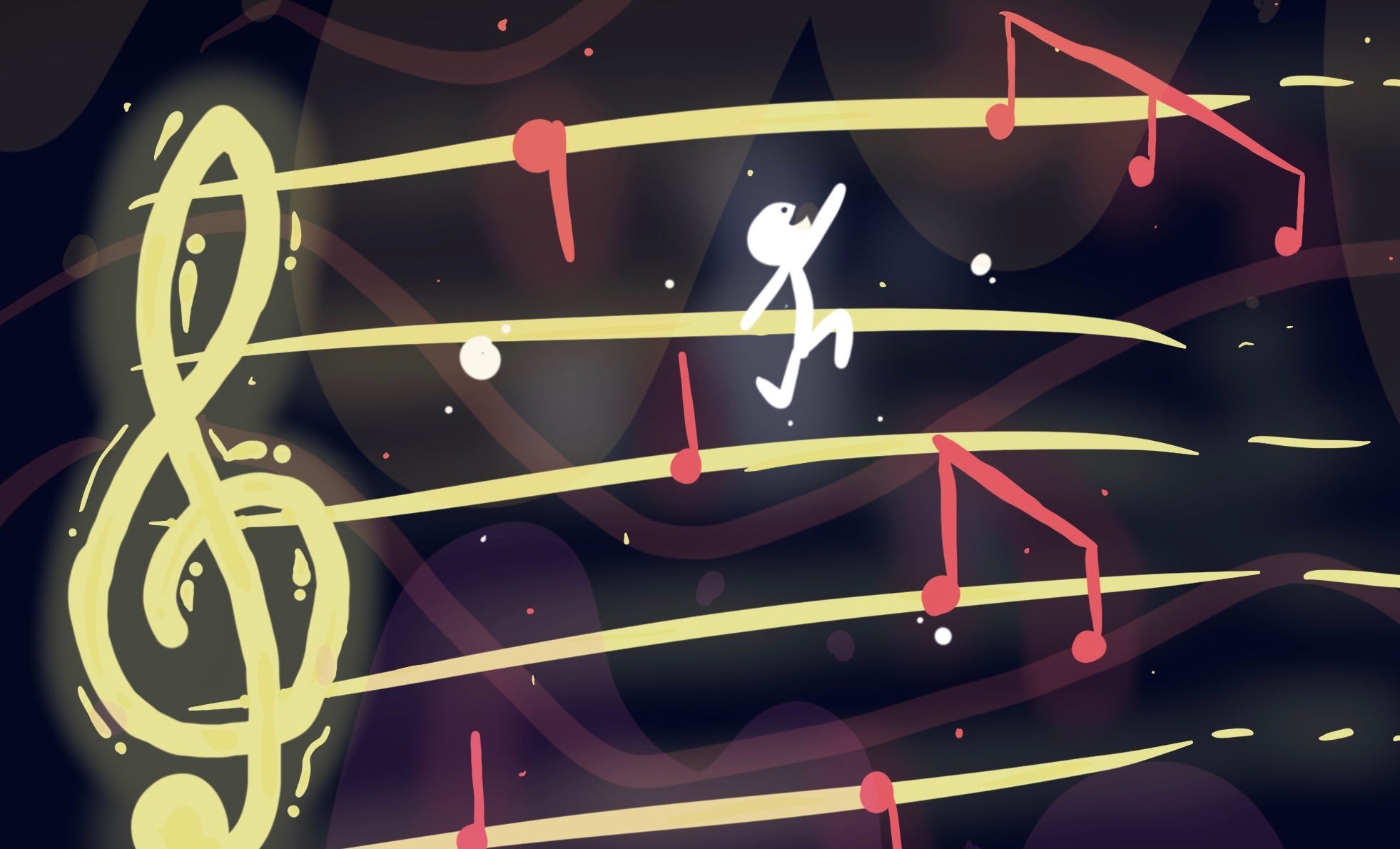
The bass guitar line of David Bowie’s “Sound and Vision” wiggles and leaps with uncontained joy. It’s a happy piece of music. The word “happy” is most at home applied to people, as in “Jones is a happy guy,” but here it has been spread beyond its home use. Such meaning spread is attested elsewhere. We say that someone is wearing a happy expression on their face, or that their crumpled posture makes for a sad slouch. Here “happy” and “sad” have been spread to their effects: a happy expression is one characteristic of people who are feeling happy; it is an expression which is a natural one for someone showing their happiness in their face to wear. Similarly, a sad slouch is a natural one for someone showing their sadness in their posture to pose in.
Can emotion terms, when applied to music, get their meaning by a similar mechanism? Focus on melodies, which “move through musical space,” some ascending step-wise from C to G, some leaping down from G to B. Appearance Emotionalism says that a happy melody is one that moves in a way that is a natural way for someone showing their happiness in their behavior to move. Same for anger, sadness, and so on.
Variation 1 of Bach’s Goldberg Variations, especially in Glenn Gould’s 1956 recording, is joyful, exuberant. Appearance Emotionalism says it moves in a way a person full of joy would move, if they showed their joy in their motion. I’ve always found this explanation convincing. In the first half the melody runs, climbs, leaps, and zig-zags effortlessly, before racing home.
I said that in “happy expression on their face” the meaning of “happy” had been spread to an effect, but that’s misleading. I can wear a happy face without its being an effect of my feeling happy, and not every face that is an effect of my happiness, is a happy face. My happiness might cause me to frown, if I am trying to hide it; and, as everyone who lives among humans knows, one can put on a happy face even when all inside is darkness and turmoil.
Nevertheless, if understood in a looser, or generic, sense, it is true that happy expressions are caused by happy feelings. A happy expression is a natural one for someone showing their happiness in their face to wear. If someone is wearing such an expression because they are showing their happiness in their face, then, in that case, the expression is caused by their happiness.
The philosopher Alan Tormey, in a book on expression, wrote that
there is a surface to expressive behavior that may become detached. The child who pretends, the actor who portrays, the mime who imitates, and the hypocrite who feigns, all attempt, in different ways, to strip the surface of expressive behavior from the character it normally reveals.
Emotion adjectives can be used to describe those surfaces, even when they have become detached from the inner feelings that, in normal cases, cause them.
Could Appearance Emotionalism be right? One might worry about idiosyncratic modes of expression. Imagine a community that carefully trains its members to show their happiness in a very slow step-step-skip gait. To them, walking that way when happy is second-nature; it requires no thought or deliberation. The first time we see it we are baffled, but after living among them for a few years we “see happiness” in this walk just as much as you ever saw it in a smile. Must Appearance Emotionalism then say, falsely, that a melody that moves through musical space in that step-step-skip motion is a happy one?
I’m not sure that community is so much as possible; nor, if it is, that the implication is false. What emotions are in a piece of music, may be relative to the ways of expressing emotion familiar to the listener, or the composer. But Appearance Emotionalism need not even grant that much. In its original form, it says that a happy melody must share a natural way for showing happiness: one that is built in to human nature. Learned means of showing are, therefore, excluded.
A harder objection is that no melody in fact moves in a way in which a human can move. Whatever exactly “musical space” is, “Twinkle Twinkle Little Star” does not move through it, in just the way any person moves through physical space. But then Appearance Emotionalism entails that no piece of music is happy, the wrong result.
The theory may be saved by the distinction, between more and less precise ways of doing something. If I raise my hand, I do so in some perfectly precise way: at a rate, for example, of two inches per second. You might raise your hand, and do so a bit faster—a slightly different way. But ways can be less precise, and there is a less precise way of raising that our hand-raisings share. I raised mine slowly; so did you.
Similarly, maybe no human can move in the precise way that the melody of “Twinkle Twinkle” moves, not least because they move through different spaces, which themselves are quite different (musical space is not continuous). Still, “Twinkle Twinkle” begins with a leap, and I can also begin my afternoon jaunt with a leap.
Stephen Davies, one of the main defenders of Appearance Emotionalism and the man who gave it that name, mentions Saint Bernards.

Saint Bernards have sad faces. Certainly, that’s not because they are natural faces for dogs to wear when sad: Saint Bernards are not beset by an epidemic of sorrow. So, if Appearance Emotionalism is right, they must be natural faces for humans showing their sadness in their face to wear. But how can that be? No one ever mistakes a Saint Bernard for a human. The answer (again) is the distinction between more and less precise ways. No human wears their face in the precise way a Saint Bernard does; physiology makes that impossible. But there is a less precise way of wearing one’s face—which includes a certain droopiness to one’s features—that humans and Saint Bernards can both exemplify.
An earlier version of this essay was published in April, 2023.
Here's another experiment. Take a simple, one-note-at-a-time melody in a major key that you would describe as "happy". Change it to the natural minor by flattening any occurrences of III, VI, or VIII.
In all likelihood, depending on the exact structure of the melody, you have drastically changed its emotional properties, and you would no longer describe it as "happy". But you have barely changed the movement of the melody through musical space. The major and minor versions of the melody still go up and down in the same places, but by a slightly different amount at certain points.
Can a single chord, which does not have any movement in musical space, be sad?