

The Book of Isaiah is full of prophesies. If their meanings may be disputed, their form is certainly obscured, as they appear in the King James Bible, for it did not distinguish poetry from prose. That is unfortunate, because the “bulk of the prophecies are cast in poetry,” and for good reason. Robert Alter writes,
In most of these texts, the prophet represents himself as the mouthpiece for God’s words...and it is perfectly fitting that God should address Israel not in prose, which is closer to the language of everyday human discourse, but in the elevated and impressive diction of poetry.
Other instances of the thought, that poetry is for the “elevated and impressive,” are everywhere. Shakespeare tended to use prose for the low or the comic, but when the time came for a king to give a stirring speech, or a prince to deliver an introspective monologue, iambic pentameter it was.
The most important moment, I believe, in the history of thought about poetic meter, occurs in Robert Frost’s letter to Walter Pritchard Eaton, dated September 18, 1915, when he writes:
I am only interesting to myself for having ventured to try to make poetry out of tones that if you can judge from the practice of other poets are not usually regarded as poetical. You can get enough of those sentence tones that suggest grandeur and sweetness everywhere in poetry. What bothers people in my blank verse is that I have tried to see what I could do with boasting tones and quizzical tones and shrugging tones (for there are such) and forty eleven other tones. All I care a cent for is to catch sentence tones that haven’t been brought to book...But summoning them is not all. They are only lovely when thrown and drawn and displayed across spaces of the footed line.
Iambic pentameter may be an excellent vehicle for the elevated and impressive, but it is also, Frost asserts, an excellent vehicle for almost any other “tone,” and for the voices of people who are neither God nor devil; and poets have been too skittish, or too blind to those possibilities, to try them out systematically. This remains true today by default, since few poets write in iambic pentameter in the first place.
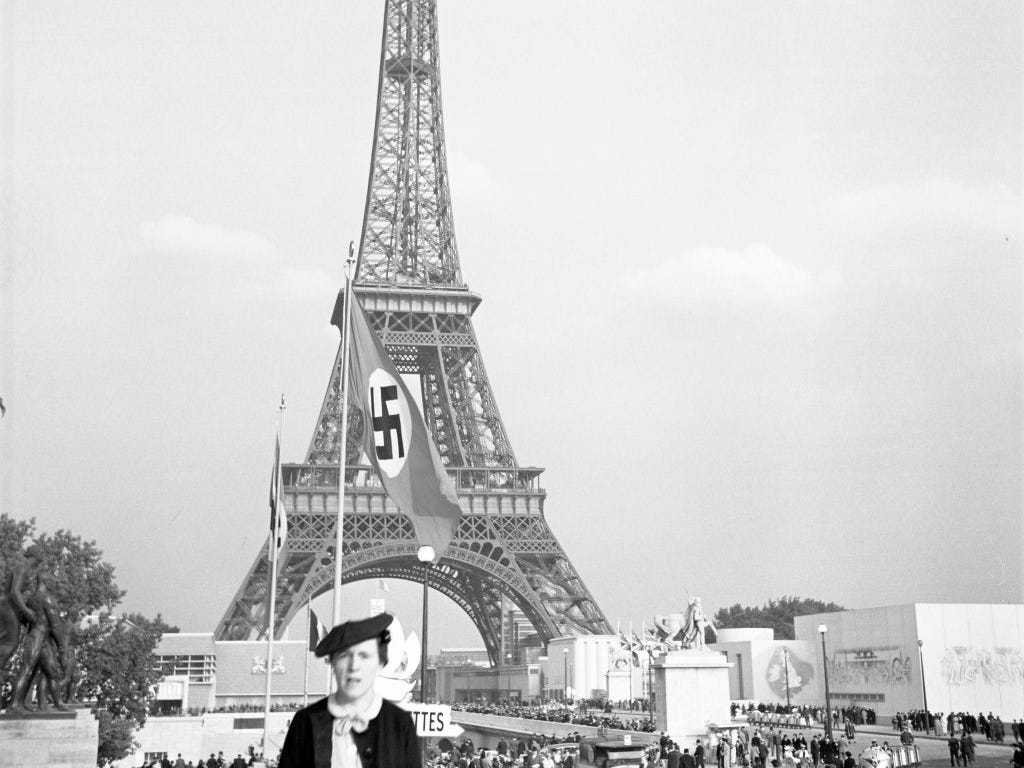
Between Marshal Pétain’s capitulation to the Nazis in 1940, and the Liberation of Paris in 1944, the French wrote over three million letters of denunciation to the authorities. After the war, some denunciations were deemed, retroactively, criminal acts: the crime of “indignité nationale.” Fascinated by their surface and their substance, I set out to write a poem based on those letters. While I admit to an interest in the more standard heroic possibilities of iambic pentameter, here my aims were Frostian. The letters are a fascinating mixture of “tones.” Rarely were the writers trying simply to convey information. They were just as keen to signal things about themselves, to the agents of the Vichy state: patriotism; sophistication; alignment with its (sick) values. They wanted to denounce “traitors,” but they wanted to sound appropriately bureaucratic in doing so. Bureaucratic tones are underrepresented in metric poetry—I’m not aware even of Robert Frost trying—but poetic they can be, when they contain an undercurrent of terror. Also poetic, in this case, is the fact that these writers’ mixed goals did not mix well: because virtue and vice do not mix well. Nor, and this is no coincidence, could the writers quite carry it all off. Their sophistication is often sour and out of tune.
That’s how it struck me, anyway. This may be serendipity, but I have leaned into it. For I should say, the letters were written in French (of course), and discussions of them referred me to a compliation titled La Délation sous l’Occupation, of which no English translation has been published. Unable to pay a real live French person to produce one, I have relied on machines to do it, machines which are, despite recent advances you may have read about, not entirely reliable. But their unreliability was, in this case, poetic, in a way worth explaining. It’s familiar enough that modern English is a mixture of German and French. Because French was, in the centuries after the Norman Conquest, the language of England’s ruling elite, French words that came to English tend to have a “fancier” meaning in English, than their originals have in French. For example, “travail” in French means (simply) “work,” but in English it means “painful or laborious effort.” Computer translations from French tend to “transliterate” French words, rather than replace them with simpler non-French words that are closer in meaning: “travails” may remain “travails,” and not be translated as “labors.” The denunciations, therefore, in my eyes, appeared to try quite hard to use the fanciest—and so, Frenchest—English words they could, even when those words were not well-suited to their intended meaning. This was, sometimes, quite amusing, as was the contrast between these elevated stylistic aims, and the sometime pettiness of the “infractions” being reported. And then, here and there, through this curtain of administrative and euphemistic malaprops, some plain and brutal language would protrude. In a poem, this could be magnified into something grotesque.
One story about World War II, is that its great evils should not be wholly blamed on a few monstrous men; shares should also be distributed to the masses of collaborators, each of whom perpetrated his or her own microdose of evil. These letters are among them, and they smell of it.
The Spirit of a Broken People:
French Letters of Denunciation
I: Salutations.
Monsieur le commissaire,
With great respect, we draw to your attention—
It is our honor to inform you that—
Duty requires that we make known to you—
We would be grateful if you would examine—
—We submit these grievances without
Prejudice, trusting you to judge their import.
II: Accusations.
This man now wears the star, and now does not
Depending on the color of the sky.
The sound is low, but through thin walls I’ve heard
My neighbors listening to the London broadcasts.
This man will sneak out early like a weasel
And go distribute leaflets in the dark.
She has corrupted children in her care,
By teaching them to call the Marshal traitor.
My daughter, now nineteen, deaf to my wisdom,
Has been enticed to ruin—by a Jew
I’m sure, for he displays a rare intelligence,
And has evaded my attempts to find
The proofs sufficient to eliminate him.
He wears the cross, and shows no hesitation
Near churches or cathedral entrances.
Two young Jews were encountered in a washroom
Immersed in shameful activities
Not relevant inside a cinema.
This man, heavily mixed with Jewish blood,
Was once my company’s director; now,
In order to evade the racial laws,
Officially he is nothing. But he sits
In the same office, and gives the same orders,
While everything is signed by a straw man.
Their flour cards are insufficient for
Their gluttonous appetites, so they’ve begun
Seeking their pleasures in black market trades.
Fat, sleek, and full of self-assurance, they
Smoke brand-name cigarettes, and throw unparalleled
Masquerades, where they dance into the night.
This Jew, convicted for illegal prices,
Has played the game of medical certificates
Declaring him unfit for hard detention.
But he is a false invalid, who now
Circulates through the town without remorse.
Disorders have been caused in Christian families
By Jewish women, who use harsh deceptions—
Inborn in them as natural endowments—
To lead our men away from pious duties
And join with them in sick and furtive acts.
Once their teeth are in, they can swallow up
Resources that were purposed to support
The needs and longings of a wealthy household.
I here abjure the privilege of revealing
Misfortunes suffered by another, but
I venture to draw your benevolent
Attention to my spare and humble case.
III: Admonitions.
Despite his brazen and revolting insolence,
This Jew, through occult powers, escapes detention.
Now the archbishop murmurs opposition
Against recent techniques of prophylaxis.
A brief report, which I prepared, contains
Evidence to defend my allegations.
And if I may confess my aspiration,
You would do well to send them to a camp.
Is it absurd to mention that a small
Lesson in terror might, temporarily,
Quell this woman’s venomous orations
Against the occupiers and the Marshal?
The overabundance of sheer documentation
That I submitted, must explain why no
Proceedings have been launched, against the hundreds
Of Levys, Hirsches, Blumenfelds, and Solomons—
Whom Germany expelled—now occupying
Remunerative situations. While
These krauts, indulged, speak everywhere like masters,
Our good French doctors have been driven out.
A ruling is required from you, regarding
Musicians of French nationality
Who likewise belong to the Jewish race.
Is it legitimate that they perform
As soloists in our orchestra? Fear not,
In this capacity no contact with
The general public will be possible.
Laden like a pack animal, with products
Destined for the black market, where the crowd
Will press in, shove, and laugh; where fearlessly
He’ll hawk old butter at a gouging price,
Tranquil and easy going: as he passes
The armed police discretely turn their backs.
I write in protest against those officials
Who advocate for leniency, when priests
Are found forging baptismal documents
For Jews. I cannot share the view that no
Evil intent accompanies these acts.
They are defrauding us, and in such cases
Laments of charity are no defense.
All these anomalies produce deplorable
Effects on French morale and national love.
Your inquiries must be more than half-hearted.
If they are energetic, if your service
Is not a myth, then I believe that my
Complaints will not remain without effect.
IV: Supplications.
We, the undersigned, here certify
That all of our constructions are in strict
Conformity to truth and to the facts.
We beg that you permit us to express
Our most profound and heartfelt admiration.
Our names should be sufficient indication
That our own Frenchness is beyond impeachment.
We are convinced you will bestow no mercy
On those who weaken us with their resistance.
Financial ruminations we forswear;
Our endless wish is but to play a part
In this essential work of purification.
Consider us at your disposal. Our
Confidence in your justice is complete,
And we trust in your cold discrimination.
We write these lines without hostility or malice.
Vive la France.
This poem is part of Interviews With Vampires. See also The Fall of France, 1940, and Occupied France, 1940-1944.
For more WWII poetry, try Prelude to a Storm, or Poets of World War II.
My book, American Independence in Verse, is available everywhere books are sold.