

Interviews With Vampires is a series of poems I’m writing about evil. Many of them are about Nazis, or atrocities the Nazis committed during the Holocaust. I can’t say I quite know why I am doing this.
Evil seems at once easy to understand, and completely unintelligible. The Nazis as a whole, and some of them individually, were bent on pursuing evil in its most pure and total form. When a thing is done as part of this project, the connection is usually easy to understand. See, to become good is to acquire the strength to do what one knows is right, and the ability to see opportunities for good that before one was blind to. The inverse of this, the truly evil man, is someone who notices ways to do evil that would never occur to the rest of us. The death camps were set up to kill human beings and dispose of their bodies with maximum efficiently, to make possible the destruction of human life on a massive scale, and their design, while horrifying, is not surprising. What’s surprising are the ancillary evils the Nazis were able to insert into the process. Why did they shave the prisoners’ hair? Wasn’t that a waste of time—in camps that often “fell behind schedule,” with transports lined up waiting to be “processed”? You might think, well, they wanted also to humiliate their victims, not just eliminate them. And that’s true. But they also packaged the hair up and sent it off to factories, to be made into textiles for personal and industrial use. It was even used to make mattresses. Who even thinks of doing that? The surprise is not that an evil person could do such things; the surprise is that anyone could have so much talent for evil, that doing them would occur to him.
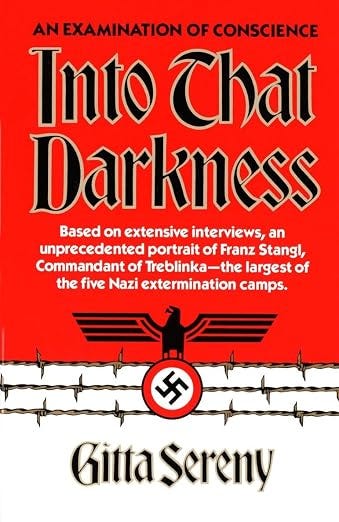
The book Into That Darkness is built around interviews Gitta Sereny conducted with Franz Stangl, the Commandant of Treblinka, in 1970 and 1971. Stangl was finally in prison for his crimes, after living many years in Brazil. “Why,” she asked Stangl at one point,
if they were going to kill them anyway, what was the point of all the humiliation, why the cruelty?
Stangl answered, “To condition those who actually had to carry out the policies. To make it possible for them to do what they did.” Sereny accepts this: “this, I believe, was true.” I was surprised she agreed so easily. Stangl makes the humiliation out to have instrumental value: it’s a means to desensitization. That cannot have been the only reason. Even if other means to that end had existed, the humiliation and cruelty would have continued. For those were, in themselves, evil, and so, for the Nazis, to be pursued for their own sake.
But when one studies carefully some of these men, and Stangl is an example, one finds them unintelligible, because the mixture of humanity and evil in their souls makes no sense. One cannot understand the inner life of someone with that particular mix. Or, one cannot imagine finding such a mix to be a stable equilibrium, that one could live with. I wrote before about Fred Leuchter. He designed electric chairs and lethal injection protocols (he was also a Holocaust denier), and was known for this and proud of it. In one scene we see that he has had custom pens made, which advertise his business. But—he also refused to be filmed smoking cigarettes, because (he thought) he was a role model for children. How is such a combination of values possible? Stangl was another man like that. Before he ran Treblinka he ran Sobibor, another death camp. Eventually his wife found out, and confronted him. “What is your part in it?,” she demanded. He answered,
My work is purely administrative and I am there to build—to supervise construction, that’s all.
This is a familiar evasion. What’s crazy is the next part of the conversation. His wife is at first relieved:
You mean you don’t see it happen?
We could talk about Stangl’s wife’s mindset too, that it’s okay if her husband works in a death camp, as long as he is not an eyewitness to the killings. But I want to stick with Stangl. For his reply to her question is shocking:
Oh yes, I see it. But I don’t do anything to anybody.
He’s gotten to a place, where seeing the killings he’s overseeing—and not being so revolted that he cannot continue—is not worse than “merely” being in charge of them; both of those huddle together on the “okay” side of some line, while way on other side, barely visible in the distance, stand those with their hands on the levers of death. In fact running a death camp is far worse than being one of the “ground troops” who pulls the trigger, or throws in the Zyklon B pellets. But Stangl thinks it’s the opposite. His powers of rationalization seem superhuman, or inhuman, if he can think that being ultimately in charge of thousands of killings a day was nothing, compared to the acts of those who implemented his orders.
Two more stories about Stangl’s strange moral compass are worth relating. A Jew bound for death complained to him that a guard had offered him water in exchange for his (the Jew’s) watch, but then never brought the water. Stangl describes his response this way:
Well, that wasn’t right, was it? Anyway, I didn’t permit pilfering...Kurt Franz [the deputy Commandant] whispered to me that the man involved could be one of the Lithuanian officers...and that I couldn’t embarrass an officer in front of his men. Well, I said, ‘I am not interested what sort of uniform a man wears. I am only interested in what is inside a man’ ... what’s right is right, isn’t it?
When it comes to the minor moral crime of pilfering—and from Jews—Stangl will exert great energies to put a stop to it. But (as Sereny reports) he was passive and helpless when it came to getting out of the genocide business.
In another episode, Stangl tells Sereny that one thing he enjoyed, in his time at Commandant, were “human relations.” That’s already a wild statement. Stangl goes on to discuss two “work-Jews” he knew, one named Blau:
Blau was the one I talked to most; he and his wife....I’d made him the cook in the lower camp. He knew I’d help whenever I could.
Stangl thinks it’s a good thing about himself, worth mentioning, that he was willing to help Blau out. One day Blau tells Stangl that his—Blau’s—father has arrived on a transport, and asks if there is anything Stangl can do. Stangl first thinks Blau is asking Stangl to spare his father, which he indirectly refuses to do, but
[Blau] said quickly that yes, he understood, of course. But could he ask me for permission to take his father to the Lazrett rather than the gas chambers. And could he take his father first to the kitchen and give him a meal.
The Lazrett was a fake hospital, where people were killed by a gunshot to the head, rather than gassed. Stangl then describes Blau returning—after his father was dead—to thank him. He reports that Blau had tears in his eyes.
Stangl is telling this story almost thirty years later. He has a clear memory of this “favor” he did for a Jew he knew well (as well as could be, I suppose, given the facts of their situation). The story is self-serving, of course, but Stangl also makes himself out, and seems sincere in doing so, to have had some true germ of affection for Blau. After hearing the story, Sereny asks the obvious follow-up question: “What happened to Blau and his wife?” And Stangl answers, vaguely, “I don’t know.” Sereny was devastated by this brief reply, because surely it’s obvious what happened to them:
This story and the way it was told represented to me the starkest example of a corrupted personality I had ever encountered and came very near to making me stop these conversations. I broke off early that lunchtime and went to sit for nearly two hours in a pub across the street, wrestling with the most intense malaise I’d ever felt at the thought of listening further to these disclosures.
The way ordinary vision works, if you can see a small thing then you can see a big one. It’s natural to think that moral vision is the same: if you moral sense is so well-developed, that you can see the minor and inconsequential good in some small act, then surely you can also easily see that something is a terrible evil; or, other way round, if you do not balk at genocide, you won’t care if you step on somebody’s toes. Stangl and others prove this is not true. Should I have been surprised? Maybe their story is nothing new, and we cannot learn even from repeated lessons: two thousand years ago Jesus asked “why do you look at the speck in your brother’s eye, but do not consider the plank in your own eye?” And maybe I’m lying to myself, when I say that Stangl’s moral life is unintelligible, rather than an extreme version of something that may be found, to some extent, in all of us. The human tragedy is that we are capable of such combinations of moral sensitivity and moral blindness.
See also: Moral Monsters.