

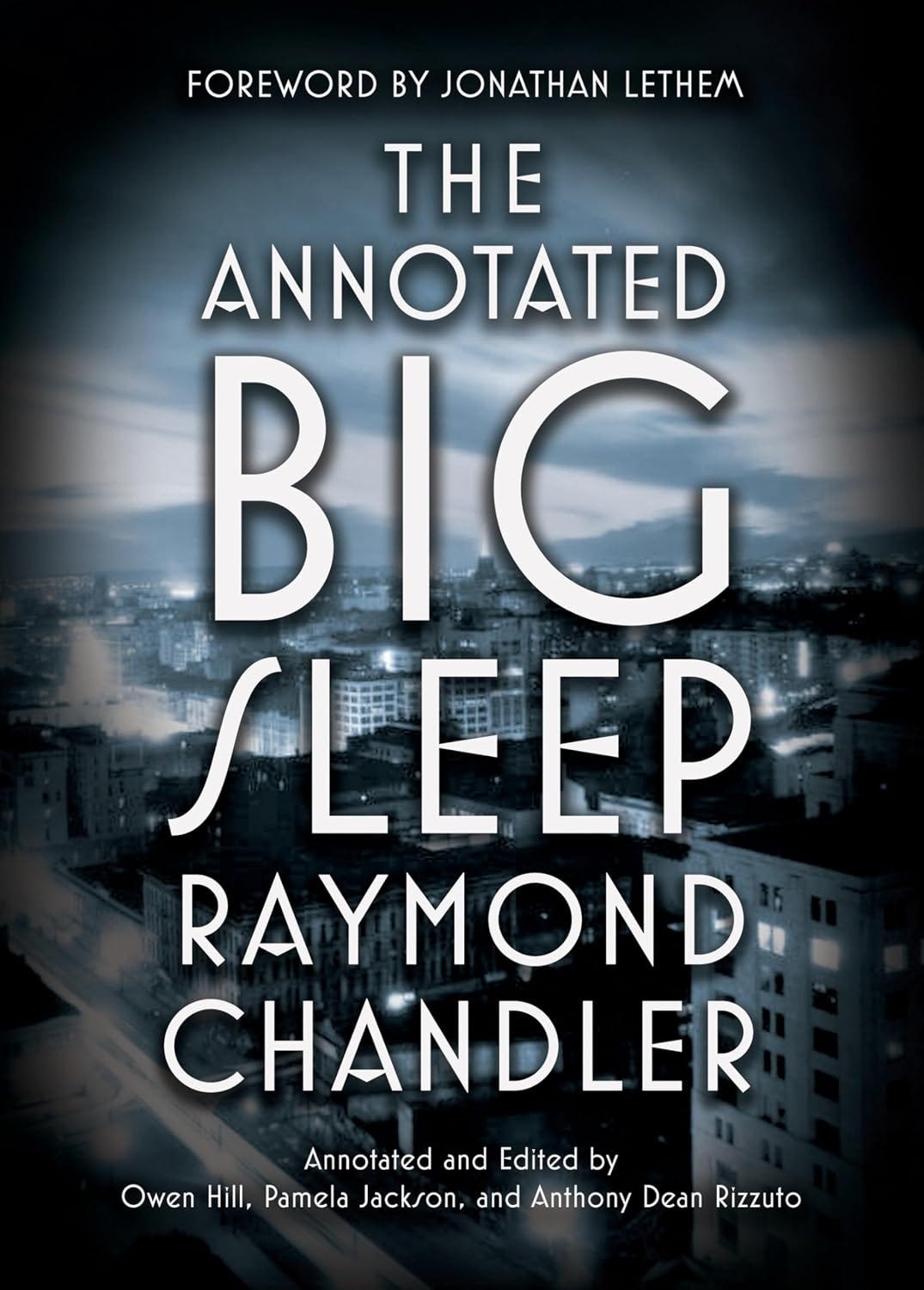
To read The Annotated Big Sleep is to endure constant interruptions by a nerdy audience eager to share esoteric facts. The left pages of this edition show Raymond Chandler’s words: a story starring private investigator Philip Marlowe, hard-boiled and on the case. Superscripted numerals are sprinkled over the text, as if an enthusiastic seven-year old were preparing cupcakes for a playdate. To each numeral corresponds an annotation on the right-facing page, and these contain fascinating expansions on the novel and the novelist, and answers to questions—when does the rainy season in LA begin, how is burbank the cloth distinct from Burbank the city—you never thought to ask. One of the annotations should explain why we can’t resist reading the side-notes when our eyes encounter a reference to them. The back-and-forth precludes settling in and enjoying the book.
But one should persist. Interleaved with the marginal marginalia is serious literary criticism, and essential information about Chandler’s view of his creation. The plot of The Big Sleep is famously opaque, and Chandler himself later admitted he couldn’t quite figure it all out himself—screenwriters for the film version wanted to know who killed Owen Taylor, the chauffeur employed by Marlowe’s client, and Chandler did not know. This public fact hints at the private truth, revealed in Chandler’s letters (and quoted in note 2 on page 83):
In the long run, however little you talk or even think about it, the most durable thing in writing is style and style is the most valuable investment a writer can make with his time.
Following this tip, The Big Sleep can be fruitfully read as a study in the simile. J. S. Bach’s The Art of the Fugue was meant to illustrate each fugual technique in a single work of art, and Chandler is doing something similar, in a pulp detective novel. I mean, there seem to be ten startling comparisons per page, sometimes more:
The light had an unreal greenish color, like like filtered through an aquarium tank. The plants filled the place, a forest of them, with nasty meaty leaves and stalks like the newly washed fingers of dead men.
Like the newly washed fingers of dead men: how did he come up with that? What did Chandler sell to the devil, for this ability? For another, here’s Chandler on General Sternwood, Marlowe’s client in the novel:
His thin clawlike hands were folded loosely on the rug, purple-nailed. A few locks of dry white hair clung to his scalp, like wild flowers fighting for life on a bare rock.
The flaw in The Big Sleep is that so much energy is put into its style, that not enough is left for character. Chandler told us what his hero means, in his essay “The Simple Art of Murder”:
Down these mean streets a man must go who is not himself mean, who is neither tarnished nor afraid. The detective in this kind of story must be such a man. He is the hero; he is everything.
The story is this man’s adventure in search of a hidden truth, and it would be no adventure if it did not happen to a man fit for adventure...If there were enough like him, the world would be a very safe place to live in, without becoming too dull to be worth living in.
In Chandler’s novels generally Marlowe is loyal, and a man of integrity; in The Big Sleep he stands by his client at great cost to himself, though it’s not clear whether or why the General deserves it. But Marlowe is still not quite human, and I was not able to care about any of the other characters, even the ones who aren’t caricatures of Bad Men or Fallen Women. The book is full of hate, love, fear, and madness, but my strongest emotional response was not to a murder or a rescue; not to Marlowe’s inevitable physical beating, or to his also-inevitable but sideways solution to the crime; it was delight in the crazy images that only Chandler can produce:
His office had the musty smell of years of routine.
The giggles got louder and ran around the corners of the room like rats behind the wainscoting.
Her whole body shivered and her face fell apart like a bride’s pie crust. She put it together again slowly, as if lifting a great weight, by sheer will power. The smile came back, with a couple of corners badly bent.
Maybe I'm unusual, but I tend to find similes showy and obvious in comparison with metaphors. Is it Frank Bruni in the NYT who once a week lists favourite bits of writing his readers have sent in? I find too many of those are too-easy similes.
I was just watching The Naked Gun (1980s and 2025 episodes) and it is based on Chandler and that genre. Lots of similes. Even as parody it works.