

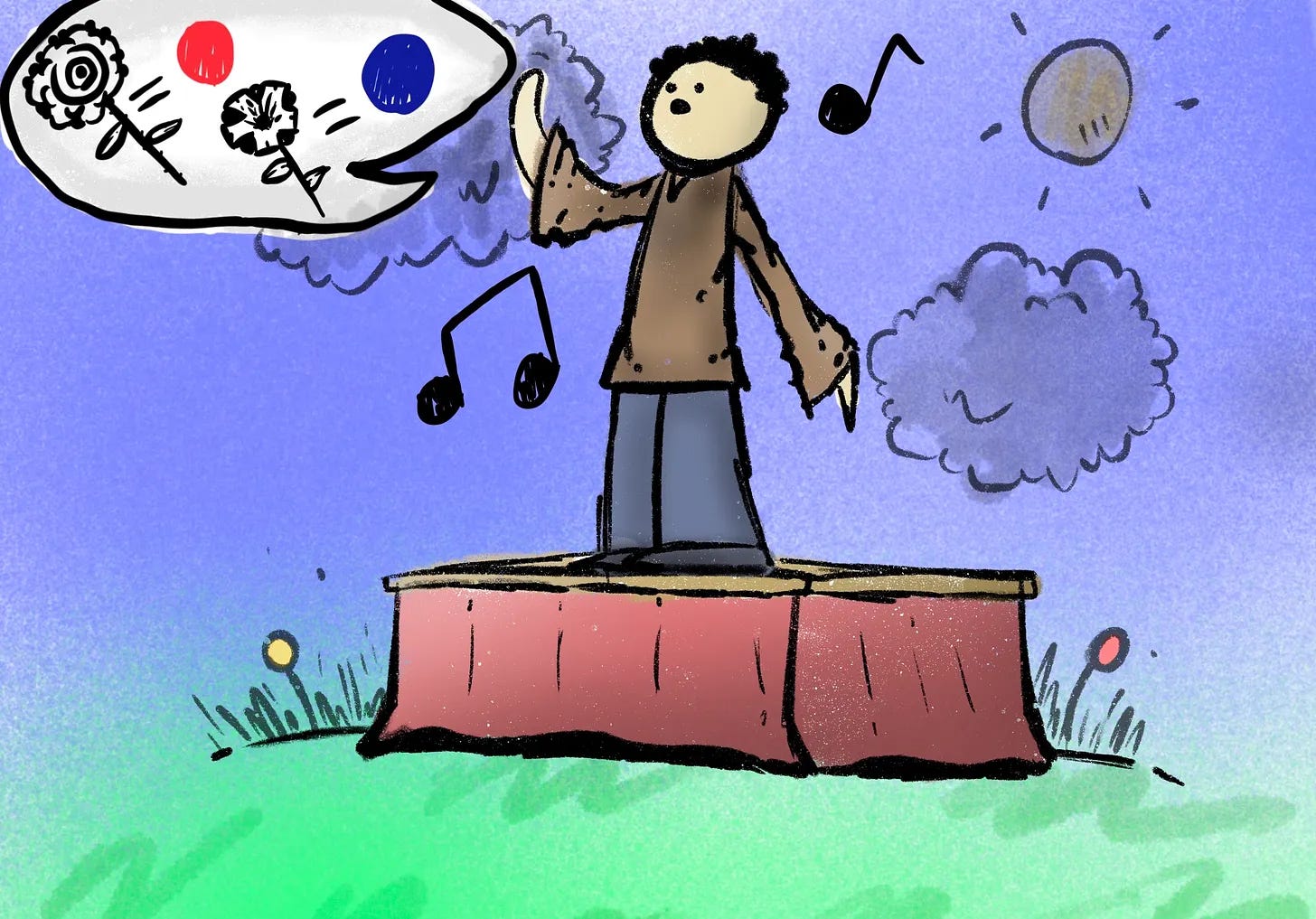
A song can tell a story or sketch a scene, as in “Hearts and Bones,” when Paul Simon sings of
One and one-half wandering Jews
...traveling together in the Sangre de Christo
The Blood of Christ Mountains in New Mexico;
or when he sings of going to Graceland, in the song by that name. A song can also communicate a feeling or emotion. Whatever else Robert Smith was aiming at, when The Cure recorded Disintegration, he wanted to convey a sadness and a longing borne of a deep desperation.
Either way, interpretive questions might arise. Wait—are they traveling together through the Flood of Christ Mountains? Does Springsteen’s “Born in the USA” express patriotic pride, or anti-patriotic outrage? There’s something to figure out; there’s something you might get wrong.
A third possibility is that a song is...whatever the listener wants to make of it. In the Epilogue to Malcolm Gladwell’s Miracle and Wonder: Conversations with Paul Simon, the two discuss Seven Psalms, Paul Simon’s new album. During the conversation Simon repeats a refrain: the listener completes the song. At one point Gladwell and Simon discuss these lines from “Love is Like a Braid”:
I lived a life of pleasant sorrows
Until the real deal came
Broke me like a twig in a winter gale
Call me by my name
By “real deal,” Simon explains, he meant “real sorrows”—true loss, compared to which one’s previous sorrows were mild, leaving room for some self-satisfaction in the feeling of them: look how deep and sensitive I am. Gladwell agreed about “pleasant sorrows,” but not about “real deal”: he thought it meant real love, or thing that really matters, as Romeo’s love for Juliet was real, and his sighing over Rosamond was not. Gladwell says to Simon,
MG: That sounds like a love song.
PS: That’s another case of the listener completes the song. Because what I’m thinking was, it’s a kind of indulgence to be moody, or this and that, feeling discouraged or something. And then an actual tragedy occurs in your life. It’s a pleasant sorrow, but when there’s a real one, when you lose someone you really like, when something really bad happens to you, then that’s sorrow. That’s not a pleasant sorrow, that’s real. The other is an indulgence.
MG: It’s funny, I’m completely reading that lyric—you’re right, I’m reading it in a totally different way—
PS: Perfectly fine.
MG: —I think I’m reading it, it’s about, that’s my life, I feel I had pleasant sor—I’m someone who married late, had children late, and I see my life was very pleasant before that, but there was no—nothing, it was sorrowful, in a sense it had no—and now the real deal’s come along...it’s funny, it’s a completely idiosyncratic, personal, reading of that—
PS: You’re not the first person to say that to me about it, to hear it that way—
MG: Yeah
PS: —that’s why I say, it’s really so, the listener completes the song. [...]
But what is this activity of “completing the song”? Simon said, and says again later, that Gladwell’s interpretation is not the one he had in mind. Why doesn’t that make Gladwell’s interpretation wrong?
Some answers can be extracted from Kendall Walton’s essay “Thoughtwriting—in Poetry and Music.” A poem might, and maybe is usually, understood “on the model of an assertive of expressive utterance, addressed to or overhead by a listener.” But another model is possible:
the model of a speech written by a speechwriter, for use by another person…[Poems] contain phrases, sentences, paragraphs, verses which readers can, if they wish, use themselves. The words are there ripe for picking, no matter what the poet was doing in writing them down, and no matter what the reader takes her to have been doing.
A poet’s words might strike me as just the right way of expressing a thought I thought I had....Alternatively, I may think of the words as clarifying my thoughts, as well as providing a means of expressing them.
In this way,
poets sometimes serve not exactly as speechwriters, but as thoughtwriters.
I’ve doubted that any poet meant a poem to be thoughtwriting. But Paul Simon says it out loud, about his songs. He thinks of songwriting as thoughtwriting. Each song is an object listeners can use to clarify or express their own thoughts or feelings. The full range of thoughts or feelings his songs might be used to express, he will not say and does not know, and nothing is wrong with listeners finding meanings or emotions he did not contemplate. Those listeners are not making a mistake, or getting it wrong, because the song is not for communicating an emotion he had in mind. This is the opposite of romanticism: making art is not offering one’s inner life to the world, it is honing a tool, to be used as suits the needs of whoever picks it up.
An earlier version of this essay was published in October 2023.
I think this is exactly right. Robert Frost once spoke disdainfully about the “detachable statements” in his work, by which he meant those catchy lines that get repeated, taken out of context, or misunderstood (“good fences make good neighbors” “the road less traveled”). I can certainly understand his annoyance—no one likes to be misunderstood, and Frost is one of the most famously misunderstood of all poets—and yet, that concept of a “detachable statement” touches on what makes Frost such a great poet. Frost is the most famous and beloved American poet of the 20th Century (rivaled only by T.S. Eliot, who had some memorable detachable statements of his own) because he was the most *useful* American poet of the 20th century: the one whose work has been most deeply integrated into the architecture of common speech.
Many of the greatest poets in history share this similar quality of utility (what Walton memorably describes as “thoughtwriting”). Everyone who speaks English has a mind festooned with phrases from Shakespeare, even if we've never read a word of his plays. And poets such as Virgil, Horace, Milton, Pope, Keats, Dickinson, etc. are best known by the public not for their poems but for their lines, many of which have been worn into a venerable anonymity by use and re-use. There are a large number of poets who are only remembered for a small handful of indelible lines: one thinks of Gray’s “mute inglorious Milton” or Cowper’s “God moves in a mysterious way” (Cowper is also the source of “variety is the spice of life” or “I am monarch of all I survey”—a pretty impressive life's work). We welcome those lines into our minds because they are beautiful, because they ring true, and, most of all, because they are useful. They express a common thought or feeling more clearly than we could have said it ourselves (“what oft was thought, but ne’er so well express’d”), and yet, at the same time, they leave room for us to use them and make them ours. They don’t insist on authorship; instead, they gift us with a thought and put a handle on it so we can take it home with us.
I remember once hearing an interview with an old retired carpenter who had spent his life making tables, chairs, bookcases, banisters, etc., for several generations of people in his community. He said that he would stop in to visit neighboring families and would often recognize a piece of furniture sitting in their living room or kitchen that he had made thirty or forty years ago for their parents or grandparents. In many cases, the owners would have no idea that he was the man who had made the table they ate at every day. He said he was delighted by that anonymity, and that the highest possible honor you could achieve as a carpenter was that people loved your furniture not because you made it, but because it was useful and beautiful enough to become a fundamental and unrecognized fixture of the fabric of their lives.
I think that the best poetry achieves a similar impersonal or anonymous utility. I know my mind is richly furnished with thoughts, phrases, and expressions that I’ve borrowed from poetry, songs, and novels. I don’t experience those thoughts as coming from some famous author, but rather as part of my own mental tool set, a part of who I am. They expand and enhance my own ability to understand myself and the world, and I am grateful for that gift. From my perspective, the greatest honor for a poet is to contribute something functional and beautiful to the furniture of the mind. It is much better for a poet to be useful than famous.