

I wanted poems that would inspire deserved admiration for those who fought and died in that war. I wanted poems about the nobility and justice of their cause, and poems bearing witness to their sacrifice as something sacred. I found none of those, in Poets of World War II. War is a horror, even a war against evil, and these poems were mostly about those horrors, or about a soldier’s disillusionment, or disaffectedness. Why is that? If you’re as close to it as these poets were, is the horror all you can see? Or was it something larger, in the culture or the spirit of the age?
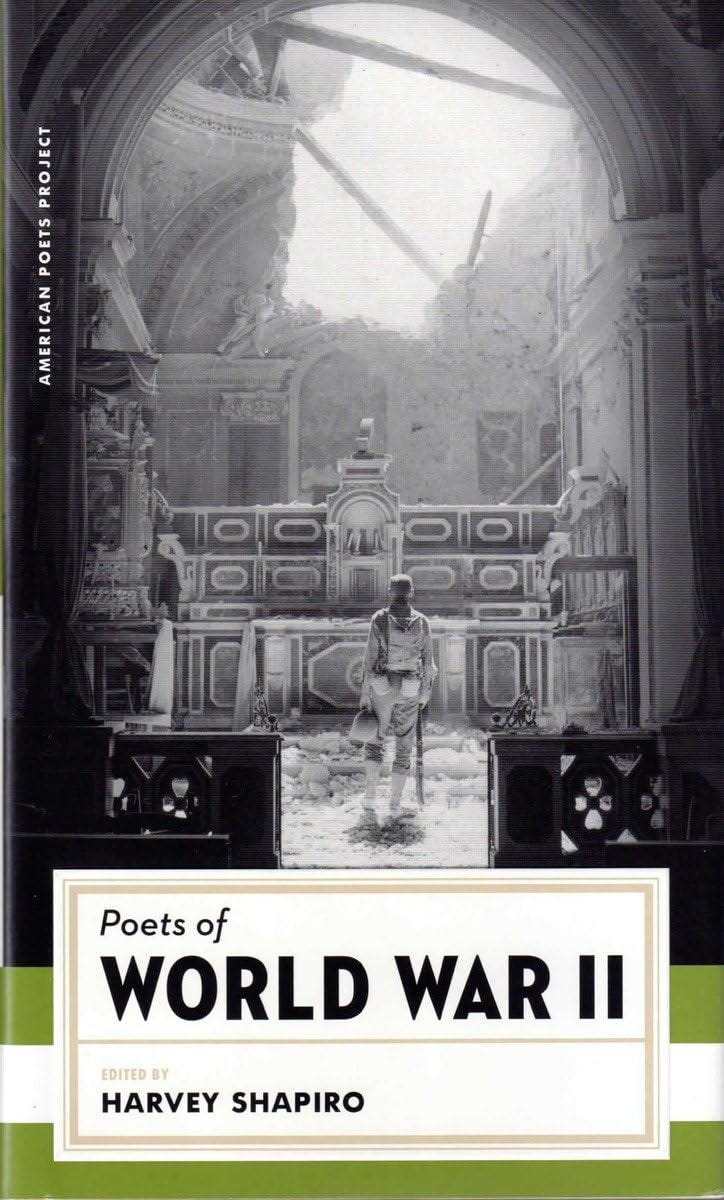
The poetry is also uneven. There are not many great ones. The best tend to be concrete, to avoid Big Metaphors, and to skirt too much Universalizing Abstraction. They also tend to be in meter and rhyme. Donald Justice said that to write in meter is “to propose that an emotion, however uncontrollable it may have appeared originally, was not, in fact, unmanageable”—maybe that’s why.
Lincoln Kirstein’s “Snatch” describes a visit to a whorehouse. Here’s a bit of it; I’ve broken his sixteeners into tetrameter pairs, both because your phone screen is narrow, and because it’s better that way:
Exhausted though still unrelieved,
   some GI’s lounge against the glass
To sip warm bear and drag dead butts
  and wait their rationed piece of ass.
...
Too bright and early to make love;
   nervous fatigue harasses haste
We’ve just been dumped upon this town.
  We’ve fucking little time to waste...
That use of “fucking” is a moment of poetic genius. The rhyming creates a fairy-tale vibe, which that word breaks through, a shattering reminder of the GI’s actual—desperate, no-nonsense—state of mind.
What’s also rare in the book, surprisingly, are narrative poems about the war’s Big Events. Operation Torch, Midway, D-Day, etc etc, there are no attempts to describe these in verse. Instead we get a focus on moments and on moods. Why this absence?
What narrative there is, rarely does enough to identify where its small story fits into the larger war. Ben Belitt, in “The Spool,” gives us soldiers on a raid:
He raises his rifle, barrel backwards, and brings
the butt down heavily on the door-panels.
The rifle rebounds.
He measures a second blow, his teeth bared
slightly in a reflex of anxiety. His eye is large.
The butt-plate smashes over doorknob and lock,
the knocker flies upward once, the panel splinters
all at once. The man kicks the door open easily
with a booted foot.
That’s okay, but the poem is marred by a distracting conceit: rather than tell the story directly, it’s told as if we are watching a movie:
A rifleman moves up the frame...
	A second figure
breaks through the frame, freezing between the
foreground and the far doorway.
“Beach Red” is a book-length narrative poem by Peter Bowman, excerpted in this collection. It scores high on concrete details, but is too prosaic—the free verse isn’t doing it any favors—and the second-person narration doesn’t really work:
Rest your body on your legs and on your arms
and for Jesus’ sake don’t let your pimply ass protrude.
Cradle your rifle in the bend of your two elbows
high enough so that no sand gets in the muzzle.
William Everson’s “The Raid” gives only hints about the time and place of the raid it describes. It’s aesthetic flaws are the opposite of those in “Beach Red”: now the writing is too flowery and tries too hard to be poetic:
They came out of the sun with their guns geared,
Saw the soft and easy shape of that island
Laid on the sea,
An unwakening woman,
Its deep hollows and its flowing folds
Veiled in the garlands of its morning mists.
Better is “The City of Beggars” by Alfred Hayes, about arriving in an Italian port after its capture by the Allies:
The wops came down to the port
When we docked
Dressed in the most fantastic rags,
Infantry caps on their heads
And feet tied in flour bags.
Better yet is “Troop Train” by Karl Shapiro, which is in excellent blank verse:
It stops the town we come through. Workers raise
Their oily arms in good salute and grin.
Kids scream as at a circus. Business men
Glance hopefully and go their measured way.
...
Fruit of the world, O clustered on ourselves
We hang as from a cornucopia
In total friendliness, with faces bunched
To spray the streets with catcalls and with leers.
...
And on through crummy continents and days,
Deliberate, grimy, slightly drunk we crawl,
The good-bad boys of circumstance and chance,
Whose bucket-helmets bang the empty wall ...
Here is a perfect balance of specificity and larger truth: the local’s reactions to the troops, who appear to them as liberators and bringers-of-plenty, contrasts with the soldiers’ vulgar reality. And at the start of the third quoted stanza there’s that stand-out line expressing exhaustion, “And on through crummy continents and days.”
In fact Shapiro has a number of good poems here. One of the great lines in the book (I’ll italicize it) is in his “Lord, I Have Seen Too Much”:
Lord, I have seen too much for one who sat
In quiet at his window’s luminous eye
And puzzled over house and street and sky,
Safe only in the narrowest habitat;
Who studied peace as if the world were flat.
If you know any poem in this book, you know Randall Jarrell’s “The Death of the Ball Turret Gunner,” and it deserves that fame. The last line is always praised, but it’s the opening image and metaphor, especially after so many weak metaphors by weaker poets, that is this poem’s greatest moment:
From my mother’s sleep I fell into the State,
And I hunched in its belly till my wet fur froze.
Jarrell is also eloquent about finding a Nazi death camp, in “A Camp in the Prussian Forest”:
Here men were drunk like water, burnt like wood.
The fat of good
And evil, the breast’s star of hope
Were rendered into soap.
But the most moving moment in the first half of the book may be in John Ciardi’s “Elegy Just in Case.” The poem opens,
Here lie Ciardi’s pearly bones
In their ripe organic mess.
Jungle blown, his chromosomes
Breed to a new address.
Ciardi continues on, about the causes and consequences of his possible death, until he breaks from that topic to address a past lover:
Darling, darling, just in case
Rivets fail or engines burn,
I forget the time and place
But your flesh was sweet to learn.
See also: Prelude to a Storm: The British Expeditionary Force, 1939-1940, in Talk to Me in Long Lines; “I was like a wounded animal…”; Interviews With Vampires.
Below the fold, more Poets of World War II, for premium subscribers: Blakean visions of bombing runs; Howard Nemerov and Richard Wilbur; Anthony Hecht’s devastating World War II poetry; and bitterness, and a refusal of glory or gratitude.