


Ugliness is the opposite of beauty. So we may learn what beauty is, by investigating ugliness, and turning the result upside-down.
Ugliness is deformity. Two arguments for this thesis may be given: an argument from the dictionary, and an argument from the writings of famous long-dead philosophers.
The Oxford English Dictionary’s first entry for “deform” is “To mar the appearance, beauty, or excellence of; to make ugly or unsightly; to disfigure, deface.” But if to deform is to make ugly, then deformity—the condition a thing is put in when something has deformed it—is the same as ugliness. This is confirmed by the OED entry for “deformity”: “The quality or condition of being marred or disfigured in appearance; disfigurement; unsightliness, ugliness.” There it is on the page: ugliness identified with deformity.
One might ask why, if there is just one thing called both ugliness and deformity, we have two words for it. But that’s not unusual; see “pig” and “swine” etc. Modern English had many parents, as Anglo-Saxon mixed with the Old Norse spoken by Viking invaders, and then with the French spoken by Norman conquerors who were themselves descendants of Viking invaders. So we’re graced with the verb “deform” from Old French, and the adjective “ugly” from Old Norse.

Important treatments of beauty in early modern philosophy assumed that ugliness and deformity were the same. Frances Hutcheson, in his Inquiry into the Original of Our Ideas of Beauty and Virtue (1725), referred to “that Form which we call now ugly or deform’d.” But Hutcheson strongly preferred “deformity” as a name for beauty's opposite—he uses “ugly” only once, here, and everywhere else uses “deformed / deformity.” This preference is manifest when, for example, Hutcheson wanted to say that the opposite of beauty is not some other “positive” quality, but is merely the absence of beauty, just as, we might say now, cold is only the absence of heat: he wrote that “Deformity is only the absence of Beauty.” It was also manifest when Hutcheson wanted to say that no beliefs or desires can influence whether we perceive something as beautiful or as its opposite. He again used “deformity”:
the Ideas of Beauty and Harmony ... are necessarily pleasant to us ... neither can any Resolution of our own, nor any Prospect of Advantage or Disadvantage, vary the Beauty or Deformity of an Object ... [you may] propose the whole World as a Reward, or threaten the greatest Evil, to make us approve a deform'd Object, or disapprove a beautiful one ... but our Sentiments of the Forms, and our Perceptions, would continue invariably the same. [italics added]
In David Hume the pattern is the same. He devoted a section of the Treatise on Human Nature (1739; section 2.1.8) to beauty and its opposite; it is titled “Of beauty and deformity.” There he wrote that “beauty of all kinds gives us a peculiar delight and satisfaction; as deformity produces pain ... These opposite sensations are related to the opposite passions.” He took a core philosophical task to be to “explain the difference betwixt beauty and deformity.” His answer, at least at this point in the Treatise, is that
beauty is such an order and construction of parts, as ... is fitted to give a pleasure and satisfaction to the soul. This is the distinguishing character of beauty, and forms all the difference betwixt it and deformity, whose natural tendency is to produce uneasiness ... beauty is nothing but a form, which produces pleasure, as deformity is a structure of parts, which conveys pain; ... the power of producing pain and pleasure make in this manner the essence of beauty and deformity.
Throughout the Treatise it is deformity that Hume opposed to beauty. “Ugly” appears only four times, and in two of those appearances it is used alongside “deformity” as a synonym: at 2.2.8.9 Hume writes, “beauty, which of itself produces pleasure, makes us receive a new pain by the contrast with any thing ugly, whose deformity it augments,” and at 2.2.9.17, “A barren or desolate country always seems ugly and disagreeable ... This deformity...”
In sum: it went without saying, for Hume and Hutchenson, that ugliness is deformity. That’s because they knew it was true.
Something is deformed if its parts, or elements, are out of place. There is a “right form” for those parts or elements to be in, and they are not in it. Being out of place and exhibiting the wrong form are not difficult concepts to grasp, but some examples may be useful. Here are some deformed daisies:
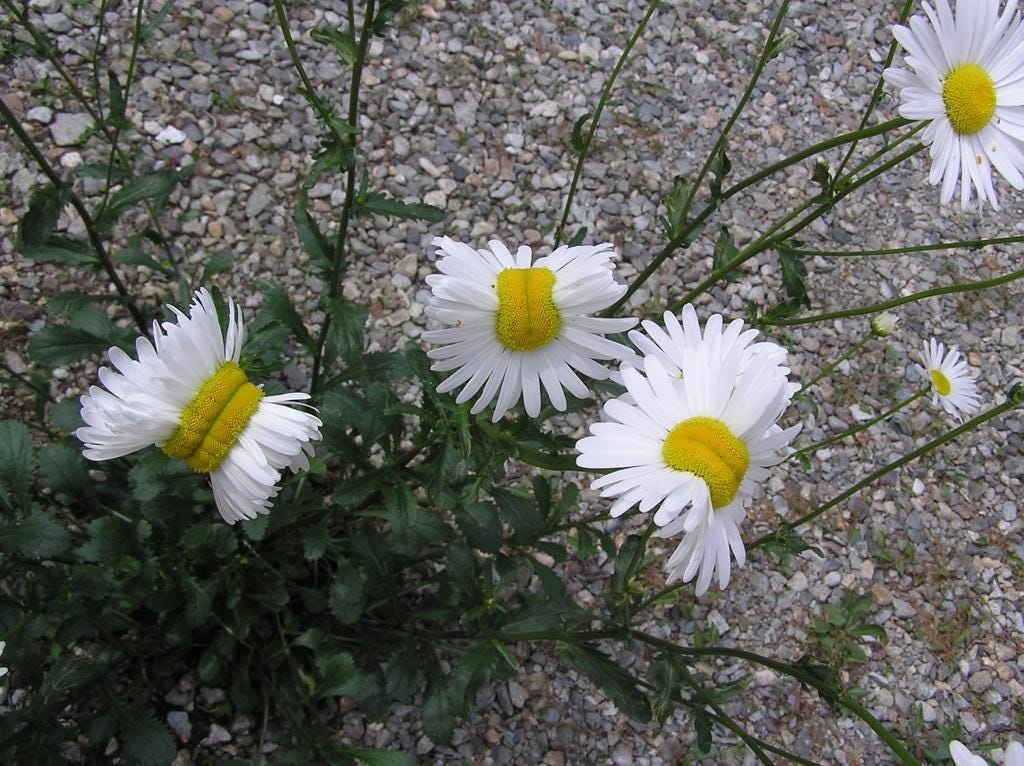
The white pedals are bent over backwards, when the right way for them to bend is outwards/forwards. The flowers’ central yellow part has been stretched to an oval, when its correct shape is circular.
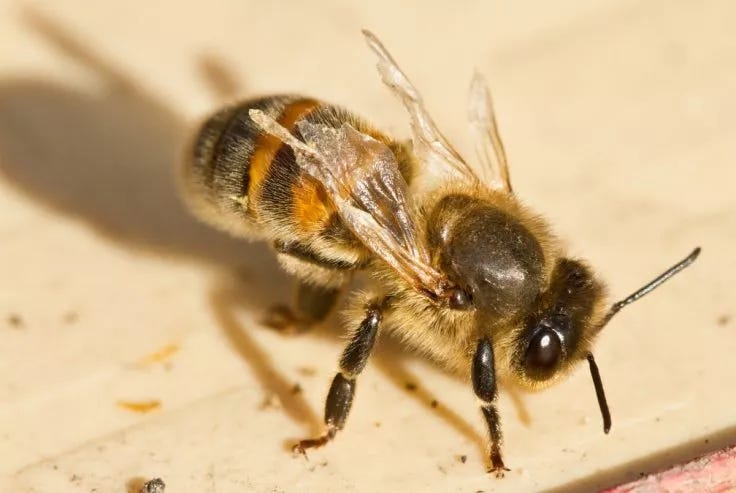
Here is a bee suffering from the “deformed wing” virus. The virus deserves its name: the bee’s wings do not exhibit the right form. (As a result the bee cannot fly.)
If ugliness is deformity, then, since ugliness is the opposite of beauty, beauty is, to coin a term, well-formity. If ugliness consists in a thing’s parts, or elements, being arranged in or exhibiting the wrong form, then beauty consists in a thing’s parts, or elements, being arranged in or exhibiting the right form. An earlier essay generalized the idea of Functional Beauty to arrive at this hypothesis; contemplating ugliness has now led to it as well. It is the Radiohead theory of beauty: everything in its right place.
An earlier version of this essay was published on March 2023.
I'm sure you are right but I still want to add my tuppence.
For me the bee in the picture is deformed but not ugly, in which case the two words can't be synonyms. Ugliness evokes a feeling of repugnance in me and a desire to distance myself from the thing yet the bee's deformity doesn't have that effect on me. Conversely, a toad is ugly yet not deformed. If I happen to touch one when gardening I recoil in disgust.
I disagree with Hutcheson that ugliness is the absence of beauty. In Jane Eyre, the eponymous heroine is said to be plain (i.e. lacking beauty) yet there is no suggestion that she is ugly. I would say Sissy Spacek was neither beautiful nor ugly but just plain.
Something that I have often thought but never read - so I can safely assume I'm wrong - is that love is a reaction to beauty. It's impossible to find something ugly that you love and vice versa. Beautiful things make me want to get near and touch them: kittens, puppies, girls' hair. I know some people claim that, say, trees or great art are beautiful but since neither evoke in me a feeling of love then I personally don't class these as beautiful. Yes, they are more pleasant to look at than at a pile of rubble yet they don't evoke that warm, melting feeling that I believe we have in the presence of beauty.