

The moment of greatest ecstasy, in any of the Holy Sonnets I-IX, is in Sonnet VII:
At the round earth’s imagined corners, blow
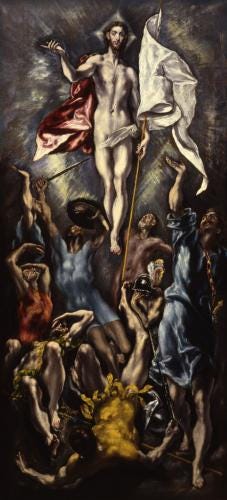
Your trumpets, angels, and arise, arise
From death, you numberless infinities
Of souls, and to your scattered bodies go,
All whom the flood did, and fire shall overthrow,
All whom war, dearth, age, agues, tyrannies,
Despair, law, chance, hath slain, and you whose eyes
Shall behold God and never taste death’s woe.
The oracular repetition of “arise”; the use of enjambment, injecting energy into the first four lines; the explosion, after so many short words, of the expansive “numberless infinities”; and again, the tightness of the list of modes of death, each mode allocated just one word, relieved by the final, line-overflowing description of those who will bypass death to “behold God.” Ah! I love it!
The rest of the poem is a let down. If the resurrection did come now, the speaker laments, he might not be admitted to heaven, so, he implores God, delay a little, and “teach me how to repent.” Now I get that the sublime joy anticipated in the octave (first 8 lines) is supposed to be balanced by a mournful, anxious tone in the sestet (final 6), but it does not quite work. The sestet is more bland than anything else, and the conclusion, that being taught how to repent is “as good / As if Thou hadst sealed my pardon with Thy blood,” is not entirely convincing. (Poems discussed here are printed in full at the end of the essay.)
If Sonnet VII represents a change of mind (“let the end times come—on second thought, I’m not ready”), then Sonnet VIII addresses a question: “How shall my mind’s white truth by them be tried?” I’m not sure what is being asked—“them” is “these souls,” which I think is God and the angels, but what is “my mind’s white truth”? The speaker’s goodness, or virtue? Whatever it means, the poem emphasizes how hard the question is to answer. It’s hard, because our minds, to those souls, are not “apparent in us ... immediately.” They are known only indirectly, by inference from observable behavior, and observable behavior may mislead, as for example when “idolatrous lovers weep and mourn.” What to do?
“Turn, O pensive soul,” the speaker instructs, “to God, for He knows best / Thy grief, for He put it into thy breast.” But this response changes the subject. The problem was how the speaker’s mind should be “tried”; the speaker hoped to make manifest the white truth in his mind. But his “solution” is advice on how to ensure God knows the grief in his soul.
There’s space to discuss one more. Sonnet I is insolent in its opening:
Thou hast made me, and shall Thy work decay?
Repair me now...
Who is this guy, who not only dares to order God around, but to argue for his order, as if holding a subordinate to account? This is your stuff, he admonishes, you’re supposed to keep it in good shape. What a contrast to the poem’s end! There the speaker is passive, pulled down “towards hell” by his sin and “iron heart.” He’s able to reverse this motion, temporarily, by looking toward God—but he may only look “By Thy leave,” and the “subtle foe” always tempts his eyes away. His only hope is that God, “like adamant,” will draw him upward. In both the tempting and the drawing-upward the speaker is the patient, not the agent: not the do-er but the done-to. What is the mental or emotional path from one to the other, and from the opening arrogant demand, to the final humble request? I’m not sure. If there’s an answer, it’s in the lines between, which express terror and despair. Maybe that terror and despair cause the earlier arrogance to crumble. Or maybe the initial command, repair me now, was not issued out of pride, maybe it’s the face of false arrogance we’re all prone to display in moments of desperation.
See also: an essay on artistic unity and Holy Sonnet XIV.
American Independence in Verse, available to order now.
The poems:
Holy Sonnet VII

At the round earth’s imagin’d corners, blow
Your trumpets, angels, and arise, arise
From death, you numberless infinities
Of souls, and to your scatter’d bodies go;
All whom the flood did, and fire shall o’erthrow,
All whom war, dearth, age, agues, tyrannies,
Despair, law, chance hath slain, and you whose eyes
Shall behold God and never taste death’s woe.
But let them sleep, Lord, and me mourn a space,
For if above all these my sins abound,
‘Tis late to ask abundance of thy grace
When we are there; here on this lowly ground
Teach me how to repent; for that’s as good
As if thou’hadst seal’d my pardon with thy blood.Holy Sonnet VIII
If faithful souls be alike glorified
As angels, then my fathers soul doth see,
And adds this even to full felicity,
That valiantly I hells wide mouth o’erstride:
But if our minds to these souls be descried
By circumstances, and by signs that be
Apparent in us, not immediately,
How shall my mind’s white truth by them be tried?
They see idolatrous lovers weep and mourn,
And vile blasphemous conjurers to call
On Jesus name, and Pharisaical
Dissemblers feign devotion. Then turn,
O pensive soul, to God, for he knows best
Thy true grief, for he put it in my breast.Holy Sonnet I
Thou hast made me, and shall thy work decay?
Repair me now, for now mine end doth haste,
I run to death, and death meets me as fast,
And all my pleasures are like yesterday;
I dare not move my dim eyes any way,
Despair behind, and death before doth cast
Such terror, and my feebled flesh doth waste
By sin in it, which it towards hell doth weigh.
Only thou art above, and when towards thee
By thy leave I can look, I rise again;
But our old subtle foe so tempteth me,
That not one hour I can myself sustain;
Thy grace may wing me to prevent his art,
And thou like adamant draw mine iron heart.
Such a beautiful reminder of Donne and what can be both arrogance and yet wry… epitomizing the naughty (I.e. thinking) child at the altar, wondering “what the fuck?” And then: “can He hear my thoughts??!!” At the same time.
But reassuring to the children in Sunday school, horrified, listening to the Parrish priest insisting that all who drowned in the Flood “deserved it”.
Such a beautiful reminder of Donne and what can be both arrogance and yet wry… epitomizing the naughty (I.e. thinking) child at the altar, wondering “what the fuck?” And then: “can He hear my thoughts??!!” At the same time.
But
Reassuring to the children in Sunday school listening to the Parrish priest insisting that all who drowned in the Flood “deserved it”.