

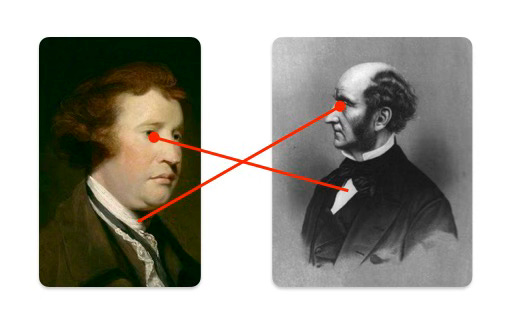
Part 1: Knowledge.
We know the sun will rise tomorrow, by “reasoning from experience.” Philosophers call it inductive knowledge. From the fact that the sun has risen each morning past, we infer that it will do so again. Not all knowledge is inductive—no insecure leap from past observations is needed, to know that 2+2=4—but inductive knowledge is important, indeed is “essential to the subsistence of all human creatures.” If previous encounters with baked goods leave you helpless before the next a loaf of bread, unsure whether it will nourish or poison you, you won’t last long.
David Hume wondered how induction generates knowledge, and found a problem: in all inductive reasoning, “there is a step taken by the mind, which is not supported by any argument or process of the understanding.” That is the step from observing a regularity, to expecting it to continue. How did we acquire the propensity to take this step? Not by constructing a proof that regularities must always continue. The continuation of regularities is not necessary, so no such proof is possible. Even if one were, you had the propensity long before you had the ability to produce proofs; you had it even in the crib, as your parents may testify. Nor could the propensity be the result of reasoning that (i) in the past, regularities continued into the future, and therefore (ii) this regularity will also so-continue. Only if you were already disposed to extrapolate past regularities, could you reason this way: the inference manifests the disposition and cannot explain it. These are Hume’s “skeptical doubts concerning the operations of the understanding.”
To these doubts Hume proposed a “skeptical solution.” The mind is “induced” to “make this step,” that is, to extrapolate, not by some argument, or the operation of (what he calls) the understanding, but “by some other principle,” which he calls “Custom or Habit.” Today, we might say this Habit was built into us by natural selection; Hume said it was part of human nature.
Reason, which for Hume is but one of the mind’s many faculties, is, Hume concludes, somewhat feeble, and we are fortunate that other mental faculties help it along, or we would know very little indeed. We are fortunate, in Hume’s somewhat unfortunate terminology, that our reasoning from experience does not rely entirely on the faculty of Reason. Reasoning from experience “could [not] be trusted to the fallacious deductions of our reason, which is slow in its operations...[and] in every age and period of human life [is] extremely liable to error and mistake”:
As nature has taught us the use of our limbs, without giving us the knowledge of the muscles and nerves, by which they are actuated; so has she implanted in us an instinct, which carries forward the thought in a correspondent course to that which she has established among external objects.

Part 2: Well-being.
One form of conservatism is a simple attachment to the familiar, and consequent resistance to change. Another form is the assertion that such-and-such form of life and of society (fill in the blank: feudal, Christian, etc)—one that, as it happens, was realized in the past—is the right one, and is known to be right; we should, therefore, return to it. This second form of conservatism is based on knowledge, but a third form, the one of interest here, is based on skepticism. What Hume said about our capacity to know, this conservative says about our capacity to live well. Edmund Burke was this kind of conservative. Explaining his opposition to the French Revolution, he wrote
We are afraid to put men to live and trade each on his own private stock of reason; because we suspect that the stock in each man is small, and that the individuals would do better to avail themselves of the general bank and capital of nations and of ages. Many of our men of speculation, instead of exploding general prejudices, employ their sagacity to discover the latent wisdom which prevails in them.
Joseph Henrich’s The Secret to Our Success is a book about culture and evolution, and a secret case for Burkean conservatism. In a chapter titled “On the Origin of Faith” he discusses the starch-rich tuber manioc, which in several parts of the world is a dietary staple. If eaten unprocessed, manioc “can cause both acute and chronic cyanide poisoning.” To solve this problem the Tukanoans, a society in the Columbian Amazon,
use a multistep, multiday processing technique that involves scraping, grating, and finally washing the roots in order to separate the fiber, starch, and liquid. Once separated, the liquid is boiled into a beverage, but the fiber and starch must then sit for two more days, when they can then be baked and eaten.
This process reduces the cyanide to a negligible, safe level. But that is not why the Tukanoans do it. Removing cyanide is not the explanation they offer for their behavior. They do it out of custom or habit. They cook manioc that way, because their parents cooked manioc that way. Henrich elaborates:
despite [the process’s] utility, one person would have a difficult time figuring out the detoxification technique … the multistep task of processing manioc is long, arduous, and boring, sticking with it is certainly nonintuitive.
A “self-reliant” Tukanoan could examine the technique handed to her by tradition, scrutinize it carefully, and try to suss out which parts of it were essential to its effectiveness:
She might … conclude that the goal of the procedure is to remove the bitter taste … She’d find that with a shorter and much less labor-intensive process, she could remove the bitter taste. Adopting this easier protocol, she would have more time for other activities, like caring for her children. Of course, years or decades later her family would begin to develop the symptoms of chronic cyanide poisoning.
“Individual learning,” says Heinrich, “does not pay here.” The Burkean conservative holds that life-plans handed down through custom are similarly opaque. Those plans are good paths to happiness and fulfillment. But clouds and storms obscure this from our view. Think it all through for yourself, refuse to take anything on trust, and your evaluations of possible life-plans will be poor if not terrible. Hume held that Reason alone can produce little by way of knowledge; Burke held that reasoning about the good life will produce little by way of well-being. In both cases the solution is the same: follow custom or habit, a process or plan handed down through generations of refinements, which ahead of time you cannot justify.
Part 3: Liberalism.
Liberalism is a canvas covered in paint splattered by a monkey. But one idea is close to its center: that people should be free to live their lives as they choose, so long as they don’t harm, or otherwise violate the rights, of others. That is hard to dispute. But John Stuart Mill, the arch-liberal, had a more extreme view: that making a reasoned choice is itself a core part of living well. And one does not make a reasoned choice, Mill held, if one does X “because that’s what we do around here.” It is this version of Liberalism that the Burkean conservative rejects. For Mill, reasoned choice is so important, that he thinks you are better off deciding that way, and ending up miserable, than being happy as a result of following custom. Mill’s conviction on this point turns his stirring rhetoric up to eleven. Following custom is not just bad, it is fit only for brute beasts:
He who lets the world, or his own portion of it, choose his plan of life for him, has no need of any other faculty than the ape-like one of imitation. He who chooses his plan for himself, employs all his faculties. He must use observation to see, reasoning and judgment to foresee, activity to gather materials for decision, discrimination to decide, and when he has decided, firmness and self-control to hold to his deliberate decision. And these qualities he requires and exercises exactly in proportion as the part of his conduct which he determines according to his own judgment and feelings is a large one. It is possible that he might be guided in some good path, and kept out of harm’s way, without any of these things. But what will be his comparative worth as a human being? (On Liberty)
In the domain of cooking techniques, Henrich refuted Mill in favor of Burke. One who eschews “ape-like imitation” and instead “chooses his plan for himself,” poisons his whole family. (In fact and ironically, the refutation goes a level up: the form of imitation by which custom is passed on and improved, Heinrich argues, is uniquely human, not something apes are so much as capable of.) Go ahead, ye Millians, and tell the lover of autonomy that, despite the evil he has wrought, his “comparative worth as a human being” remains higher than that of his custom-following neighbor, who is smiling and playing with his grandchildren. And if Mill was wrong about culinary techniques, how right could he be about Bigger Topics, say, whether to get married and raise a family?
I suspect, though, that a True Conservative won’t trouble too much about whether living as Mill directs us is a Bad idea. He’ll suggest that, in any regard, living that way through-and-through is impossible. Those who defy one tradition only do so by acquiescing in another. It’s like Saint Paul’s idea in the letter to the Romans, that to be “set free from sin” one must become a “slave of righteousness.” Or Bob Dylan, who’d read Paul, singing “Gotta Serve Somebody.” The Christian philosopher Peter van Inwagen puts it more clearly if less memorably: “each of us accepts certain authorities and certain traditions,” even those of us who believe that we trust only ourselves, and that we critically examine everything before accepting it. Here the Burkean view gets complicated and difficult. In small close-knit communities there may be just one tradition, or set of customs and habits; but in our cosmopolitan world there are many, and some are better than others. Van Inwagen divides them into two camps, and says you likely “trust one or the other of two authorities: the Church or the Enlightenment.” He is an “apostate” of the Enlightenment, now finding that “its social consequences,” and its effects on those who live according to its tenets, “have been horrible.” But these are the words of someone guided by the customs and the habits of the Church. What if you agree that complete autonomy is impossible, but are anxious about which tradition should be yours? You want to live according to the better sort of tradition, but how? Stick where you started, hoping you were lucky and were born in the right place? Or, what? Use your Reason to decide between them?
See also: Edmund Burke and the Limits of Pragmatism.
Sources: David Hume, An Enquiry Concerning Human Understanding; Peter van Inwagen, Quam Dilecta.
An earlier version of this essay was published in November 2023.
I remember the earlier version of this essay. I’d never heard of manioc and that case stuck with me. Nice to revisit this.
Interesting stuff—the questions you raise at the end are difficult but important, and they remind me of a lot of what some poets I know on Substack were saying after Wendell Berry’s passing…