

A different version of this review was first published in New Verse Review; thanks to Steve Knepper, the editor.
Entire years of your life will blur together, or be forgotten. When you notice this in middle age you’ll become a little desperate, and you’ll try to rescue what is left and wrestle with its meaning. The poems in The Discarded Life are such an effort.
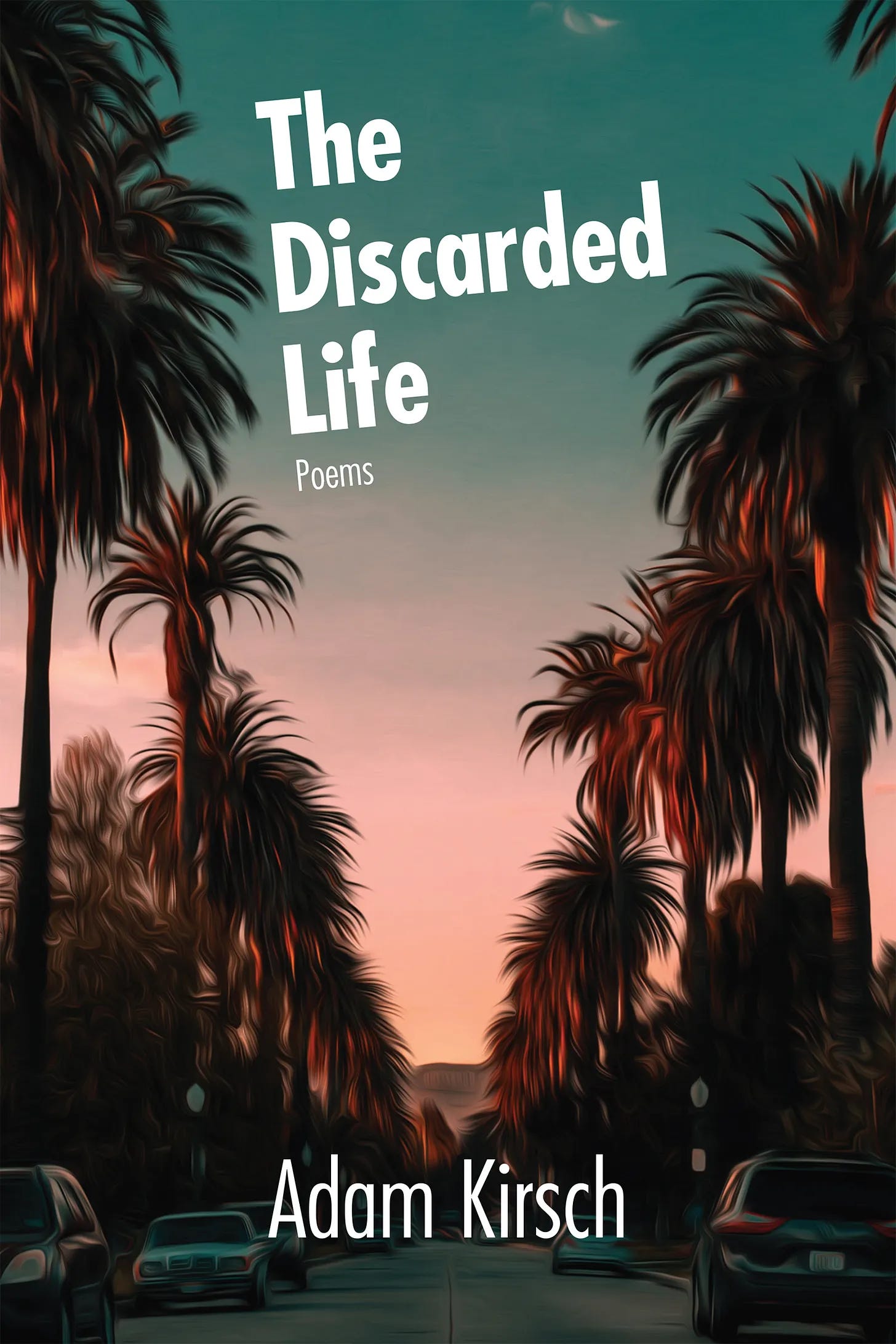
One of the poems’ pleasures is how well they evoke a time and place. We are in Southern California, in the early 1980’s. (I grew up there in the same decade.) The Muppets, Atari games, and Sesame Street all make appearances, against the almost-imperceptible gradations of climate that that place calls “seasons”:
The most of winter that we ever knew
Was a gray, cloudy tincture of the air[.]
For those who did not live through it, the technology of the time will seem insanely primitive, as far from us as the turn of the 20th century was to them. The absence of the internet is only the tip of the iceberg. Kirsch remembers the limited graphics of one video game, which were
All that the bulky monochrome display
Could generate from five-inch floppy disks
You had to keep inserting and withdrawing,
Like turning hand cranks on an early Ford.
While Americans worried about nuclear war, Southern Californians prepared for other disasters. I myself remember the regular drills, but not whether they were for earthquakes, wildfires, or a meltdown at the local nuclear power plant. Kirsch describes a fire coming to his summer camp:
…red smoke drifted close enough to make
Our eyes burn like the chaparral around us,
and I don’t think I’ve heard the word “chaparral” since I moved away.
Kirsch writes in blank verse, and shows by example that a wide range of rhythms can fit inside the iambic line. These two verses—
And night drives on such unfamiliar streets
Their thin trunks and attenuated fronds
—have strong accents on the third syllable (“trochaic substitutions”) without a prior pause, which primers on iambic pentameter say is a no-no, but is actually fine, and quite expressive.
Because Kirsch’s meter tends to strictness, the deviations make for powerful effects. Here is one, in the fourth line quoted below: after the first Gulf War, a “kid who’d taken French with us” returns to
…tell us how
It felt to sit inside a desert tank,
Waiting for the order to advance:
Hot. If there was something more to say,
He didn’t think we were prepared to hear it.
The pointed brevity of the description—“hot”—is made more pointed, by fronting a headless line (that is, one missing a first, weak syllable).
It can be enough, I believe, to put sights and sounds into poetry, and let the reader decide their significance. When the poet himself tries to articulate an abstract moral, he risks banality. Kirsch takes the risk, and does not bat a thousand. The poems contain their share of trite conclusions, blandly stated:
Good is what we have to seem to be,
Not something anybody ever is.
But they also make their share of observations that are surprising despite being obvious, as when a student at Kirsch’s school dies, and
…Later on,
A patch of garden named for Julian
Was planted in the schoolyard, with a plaque
That meant a little less with every year.
The best-developed metaphors in the book are about smoking:
…I learned to hold a cigarette
With the same fingers that could take a pen
And flick the words like ashes down the page,
Leaving a record of the life consumed.
Another expresses the indifference to the dangers of smoking that is the privilege of youth:
The thought that every cigarette I smoked
Subtracted minutes—eight to ten, I’d heard—
From the tall, toppling stack of time I owned
Could not discourage me […]
To lose all this, and still have more to lose!
Who wouldn’t trade the ash-end of existence
For the controlled burn of a summer night…
To lose all this, and still have more to lose.
The worst poem is number 38, which suggests that children are born only “to gratify [their] parents’ urge to love,” and that it might be better “To leave the child beneath the throne of God, / Unembodied and unhurtable”: an off-putting sentiment. The best is number 16, which suggests that all those duck-and-cover earthquake drills
Were less like preparation than appeasement,
As though the Big One would be satisfied
By all these recognitions of its power
And not be tempted to a demonstration.
A final turn occurs at book’s end, when what has seemed to be an exercise in holding on to the past, is revealed to be the opposite:
Poetry is a method of disposal,
Giving a decent burial in words
To the discarded life I have no use for—
Or else a way to throw it overboard
As the balloon jerks higher toward the sun.
I'm about to write something political, even didactic. What do you think differentiates the successful from the unsuccessful summation of a point, or drop of wisdom. Asking for a friend.