

1988 was, for George Michael, “what pop critics call an ‘imperial’ year.” He “reigned over the charts and, essentially, could do no wrong.” It was the year of Faith, his debut solo album, which spent twelve weeks at number one, and produced four number one singles, each of which, if you were alive at the time, you can still hum today. Chris Molanphy, on his Hit Parade podcast, explains “imperial period” with the paradigm case, the most imperial of imperial periods by any pop musician: Elton John, 1970-1975. In six years Elton John recorded and released seven consecutive number one albums, and it all peaked in 1975, when he sent three singles and three separate albums to the top of the charts. One of them, Captain Fantastic and the Brown Dirt Cowboy, was the first album ever to debut in the number one spot. First album ever: no one had done this before, not the Beatles, who set so many chart records, nobody. Molanphy says,
there have been other imperial stars across pop history, from Elvis Presley to Michael Jackson to Justin Bieber. But Elton John’s Imperial Period was both extraordinarily prolific and concentrated, with a dizzying schedule of smash albums and singles, practically every month. Looking back on this period, a decade later, in a 1987 British interview, Elton didn’t say the word imperial, but he defined it perfectly:
Q: is there a period that you think was your most fruitful songwriting period?
A: ...obviously, you know, in the early 70s or in the mid 70s when we could do no wrong....if you’re successful you get to a point where you can’t do any wrong, it’s like Madonna goes through that period at the moment...you can’t fail.
Randomly-sample the greats, and it is evident that most of them do indeed “get to [that] point”: Elvis, from “That’s All Right” until the army; The Beatles from Rubber Soul to Sgt Pepper; The Rolling Stones from Beggars Banquet to Exile on Main Street. Fill in the blank.
For Elton John, the 1975 peak was also the end. Immediately, song quality and quantity declined, and audiences turned against him when, in a 1976 interview, he outed himself as bisexual. He became, in Molanphy’s words a “modest, second-tier pop act.” This fall is part of the paradigm. When Elvis died in 1977, “all alone,” as Gillian Welch sang, “in a long decline,” John Lennon quipped that “Elvis really died the day he joined the army.” There was a brief comeback (the 1968 Special, and From Elvis in Memphis), but the music was never the same. Here as ever Elvis set the trend: comebacks come and comebacks go, but almost never is the throne reclaimed. The fall is often scary-steep. Goat’s Head Soup, The Stones’ follow up to Exile, has a few good tracks, but mostly it sucks. After Born in the USA, certainly one of the greatest rock albums, Springsteen’s next few albums disappoint. Violator by Depeche Mode is note-perfect and so much better than every subsequent album they’re put out—I’ve bought them all with hope in my heart—I wonder it’s the same band. And the phenomenon isn’t limited to Boomer / Gen-X elephants.
These repeated tales of masters so divine in their powers losing their touch so quickly can make those of us in middle age quite anxious. These stories move us so strongly, in part, because they could be mistaken for the stuff of myth.

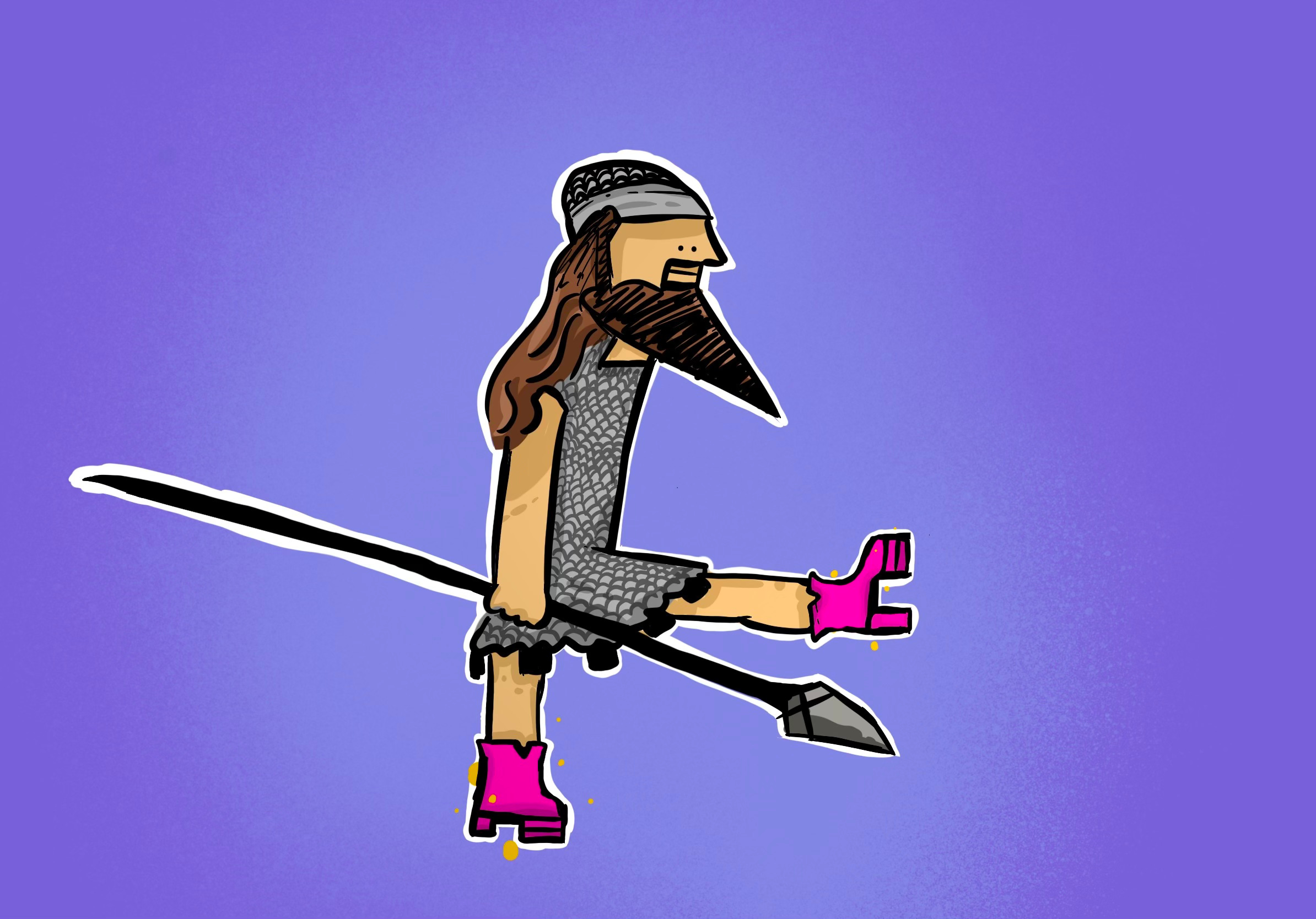
The aristeia is “the main compositional unit of battle narrative” in Homer’s Iliad.1 In it “the excellence or prowess of a Homeric warrior” is on display, as he “sweeps all before him, killing whoever stands against him.” In the oral tradition from which the Iliad derives, audiences expected the aristeia, and knew its conventions; they could “appreciate both the fulfillment of the norm and artful, meaningful variations on it.”
When the hero displays god-like powers, it’s because his powers have been enhanced by the gods. In Book 5 of the Iliad Athena “gave to Diomedes / courage and energy, so he would win / great glory and shine bright among the Greeks.”2 “She spurred him to the center of the fray,” where he “routed the dense ranks / of Trojans, forced them into retreat,” and Homer compares him to “a downpour sent by Zeus,” washing away every dam and fence. When Diomedes is shot by a Trojan archer, a comrade pulls out the arrow, and Athena “made his feet and hands and limbs feel nimble, / and stood beside him, speaking words on wings,” urging him back into battle: “In your chest I put / the dauntless courage that your father had.” Ready with aid throughout, Athena at one point steers Diomedes’ spear “beneath [Pandarus’s] eye and through his nose, / smashing his white teeth”; and later, emboldened, Diomedes does battle with, and gets the better even of Ares, god of war.
But eventually a hero’s aristeia ends, but woe betide he whose aristeia ends mid-fray, divine favor removed and the shield-wall opening a flood of charging Trojans.
Calling aristeia a “compositional unit” suggests it’s a convention attached to a genre. But aristeia is also a real phase in real life-histories. In a culture where glory was available in battle, the portraits of aristeia were bloody, but prowess and excellence are available in many domains, and therefore so is aristeia. Elton John’s imperial period was his aristeia: greatness was effortless, everything he touched turned to gold, and drugs and other debaucheries could be enjoyed without causing distraction or diminution of the work. Aristeia, in anticipation, is the brass ring you’re reaching for, and the vision you will manifest, as you stumble through the twentieth mile, nail another rejection letter to the wall, and wipe the latest thrown-tomato from your face. And then afterward, looking back, it’s apt to cause nostalgia or depression.
Aristeia comes to those who are prepared. Diomedes—or Meneleus or Achilles, each of whom has an aristeia in the Iliad—did not spend the years before the Trojan war eating potato chips on the couch. But also it comes to those who are in the right place at the right time. A soldier’s aristeia can come only in battle, and so in a time of peace none are to be had. Elton John was a musical genius who studied at the Royal Academy of Music, but also 70’s pop music audiences were in just the right 50s-nostalgia mood to receive Crocodile Rock. I remember Bill Clinton lamenting that no wars were on the horizon, through which he could elevate his presidency to the American pantheon of Washington, Lincoln, and FDR. Yet still, preparation and context together are not enough. The final ingredient is divine aid or inspiration. It’s Athena guiding Diomedes spear; it’s Paul McCartney finding the words “the movement you need is on your shoulder” in, of all years, 1968. Without something watching over you, a well-trained soldier may die early from a chance arrow, or see only minor skirmishes on the margins; a band might break up before its evident chemistry produces any hits.
These days I think aristeia, and imperial periods, they’re a trap. Held up as ideals, they are apt to cause burn-out in the young, and dejection in those past their prime, or who never had a prime. Hasn’t imperialism had its day? Even Neil Young, in the end, preferred fading out to the alternative. I think about Paul Simon, who had at least two imperial periods himself, the last ending around 1991. Since 2011, when he was seventy years old, he has put out four albums, none of which muscled all competitors aside to tower over the musical landscape. (To be fair, they did sell.) But they’re the best work he’s every done; better, I will say it, than Graceland. I look ahead to a long future of steady work.
An earlier version of this essay was published in November, 2023.
Seth Schein, The Mortal Hero: An Introduction to Homer’s Iliad.
Iliad quotations from the Emily Wilson translation.
Great essay. I don't agree with the ending. You have to try, even though you never know when Zeus's lightning will strike. If an artist puts out his best work but the people don't crowd around it, that is not lack of aristeia, but fate, in the Homeric parlance, dictates that it falls on deaf ears for the time being. Unless you are saying that aristeia requires collectively recognized results, and not an isolated excellence. There is something to that, but the difficulty of achieving it does not mean you should give up.